
Coding agents can already write a routine pull request. The hard part is everything around it: knowing which tickets an agent can take, keeping it inside the team’s rules, and checking what comes back. Without that, a company’s best engineers end up babysitting agents instead of building.
SuperPlane is made by the team behind Semaphore, the CI/CD platform used by Confluent, Replit and Superhuman. Their answer is a software factory on an open-source engine: agents plan, code, test and verify, and hand the work back to a person only when judgment is needed.
The brand had to explain a new category to engineering leaders who have seen every AI demo of the last two years.
Elon Musk describes a company as a sum of vectors: every person pushes in some direction, and progress is what adds up. We rewrote the line for teams where a growing share of the work is done by agents.
A vector has length and direction. Agents add length: more work, done faster. Pointed different ways, they cancel each other out and leave a mess in the codebase. SuperPlane sets the direction, so the work adds up.
That gave the brand one element to build everything on: the arrow. A short film tells the idea. The line types out word by word and the word vector turns into an arrow. A field of arrows spins in every direction until one wave turns them the same way, and their sum becomes the mark.
SuperPlane guardrails every agent: plan, code, test, verify, then hand back to a human, only when judgment is needed. The guardrails are not fixed. They are a living system that grows with the team instead of freezing it in place.
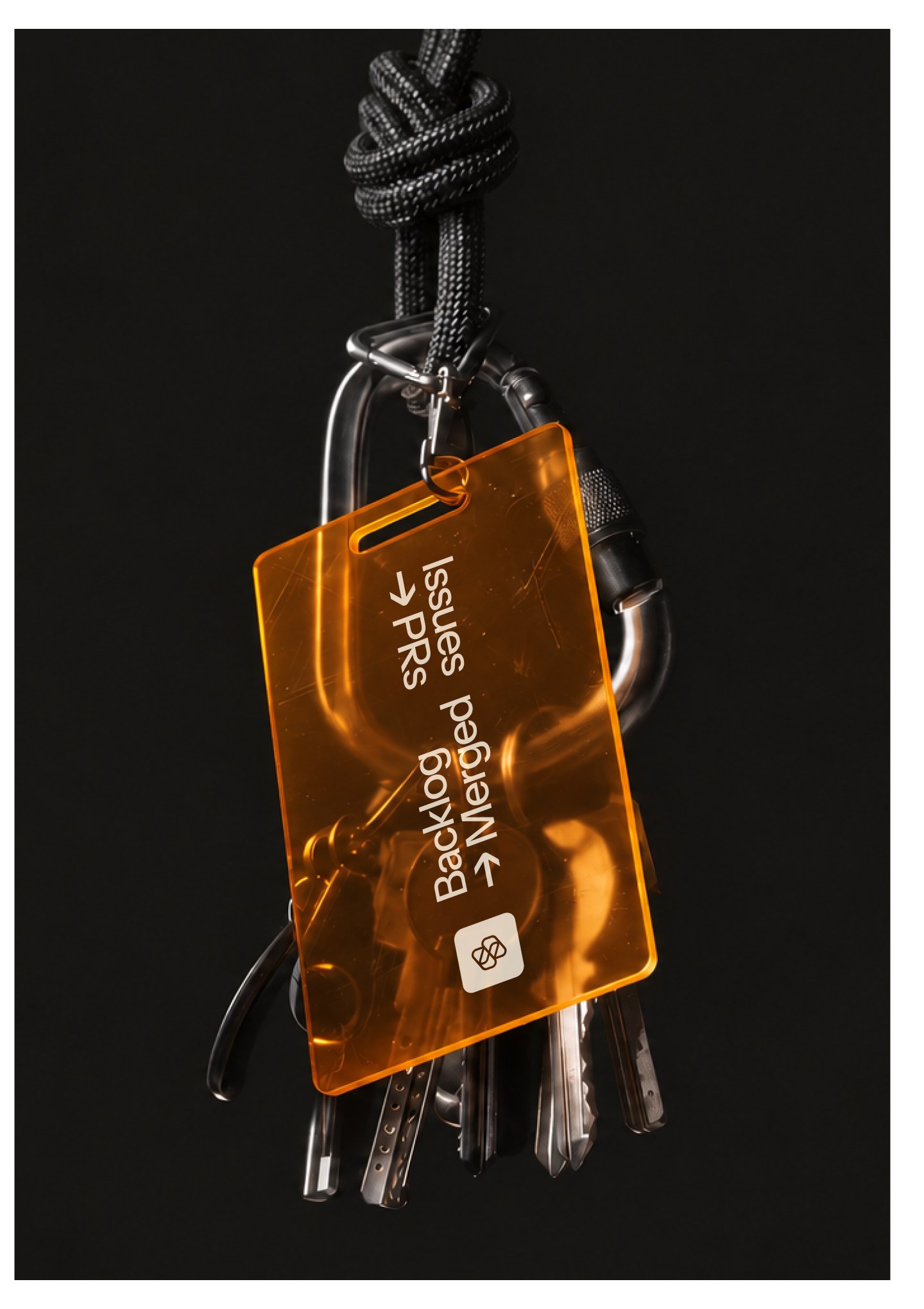
In the copy, the arrow does the work of a verb. Headlines are written as input → output: Issues → PRs. Detection → Recovery. Engineering tasks → 30% one-shot. Each one says what goes in, what comes out and which way the work moves.
The mark comes straight from the product: two workflow cards joined by a connector that bends into an S, the first letter of the name. It also shows what SuperPlane does. It connects each step of the work to the next, from the people who set the direction to the agents that carry it out.
The palette is built for engineers who live in dark mode: Pitch, Deep Teal and Cloud, with Signal Orange held back for the moment something moves. Instrument Sans carries the voice and Roboto Mono the numbers, the way they look in a terminal.
Illustrations are drawn with arrows too, and the line icons sit on one grid with one stroke weight.
We wrote a generative engine for the brand. Thousands of arrows move as a field, gather into a globe, flock like a school of fish or fly toward the viewer like stars. They react to the cursor: move the mouse and the arrows turn and follow, the way SuperPlane points agents in one direction.
The engine runs live on the site, behind the final call to action and inside the onboarding demo, and exports frames and video for posts, slides and event screens. Post covers for LinkedIn are built from the same arrows and the same grid.
The site makes one claim and proves it on the first screen. The headline says SuperPlane one-shots 30% of engineering tasks. Right under it, a task board does exactly that: a ticket leaves the backlog, the agent checks how clear it is, gets one note from the engineer, writes a plan, runs it and moves a review-ready card to Done.
We designed and built the site, with the product shown in working interface blocks instead of screenshots.
The board is code, not a video. It loops in about 15 seconds, and a visitor sees the product work before reading a line of copy.
The onboarding demo walks through setup the same way: connect GitHub, pick an organization and a repository, and the workspace starts running, with the arrow field changing at every step.
The open-source engine behind the factory has more than 7,000 stars on GitHub.
The Metabrand team thanks SuperPlane co-founders Darko Fabijan and Marko Anastasov for their trust and input, which made it possible to build the brand at full scale.