By clicking "Accept all cookies", you agree to storing cookies on your device to enhance site navigation, analyze site usage and assist in our marketing efforts as outlined in our privacy policy.
By clicking 'Accept all cookies', you agree to storing cookies on your device to enhance site navigation, analyze site usage and assist in our marketing efforts as outlined in our privacy policy.
Every competitor looks the same. Blue logos. Geometric sans-serif fonts. Abstract gradient illustrations of happy people collaborating. Screenshots with perfectly organized dashboards. Messaging that promises to "streamline," "optimize," and "transform."
Scroll through any SaaS directory — G2, Capterra, Product Hunt — and try to remember any specific brand after five minutes. You can't. They blur together into an indistinguishable mass of sameness.
This is a problem because B2B SaaS is also brutally competitive. Most categories have dozens of viable options. Buyers are overwhelmed. They don't have time to deeply evaluate every alternative. They use shortcuts — and brand is one of the most powerful shortcuts available.
The companies that break through — Stripe, Notion, Figma, Linear, Slack — don't look like everyone else. They have distinctive positioning, memorable visual identity, and consistent voice that makes them recognizable in a sea of sameness.
This guide covers:
Why B2B SaaS branding is different from consumer branding
The unique challenges of the SaaS business model
Building trust and credibility signals
Positioning in crowded categories
Visual identity strategies that differentiate
Messaging for multiple stakeholders
Brand's role in the SaaS growth engine
Case studies from companies that got it right
Let's build a B2B SaaS brand that actually stands out.
B2B SaaS Branding Agency operates under different dynamics than consumer brands. Understanding these differences is essential for building an effective brand.
Multiple Decision-Makers
Consumer purchases are usually individual decisions. B2B SaaS purchases involve multiple stakeholders:
Technical evaluator: Often the person who will use the product daily. Cares about functionality, usability, technical architecture, integrations.
Business buyer: Usually a manager or director. Cares about outcomes, efficiency gains, team adoption, ROI.
Financial approver: CFO, finance team, or procurement. Cares about cost, contract terms, vendor risk.
Executive sponsor: VP or C-level who champions the initiative. Cares about strategic alignment, vendor stability, career risk.
IT/Security: In enterprise deals, IT and security teams review technical and compliance requirements.
Gartner research suggests the average B2B buying group involves 6-10 decision-makers. Your brand needs to resonate with all of them — each with different concerns, different language, different evaluation criteria.
This is fundamentally different from consumer branding, where you optimize for one person making one decision.
Longer Sales Cycles
Consumer purchases happen in minutes or hours. B2B SaaS sales cycles span weeks or months — sometimes quarters for enterprise deals.
During that time, prospects encounter your brand repeatedly:
Initial awareness (ad, content, referral)
Website visit and exploration
Content consumption (blog, case studies, documentation)
Demo or trial
Sales conversations
Internal champion pitching colleagues
Procurement and security review
Contract negotiation
Each touchpoint either builds or erodes trust. Brand consistency across this journey matters enormously. A disconnect between your marketing website and your product UI creates friction. A mismatch between sales deck claims and actual capabilities destroys credibility.
Higher Stakes, More Risk Aversion
B2B buyers spend company money, often with career implications. A bad software purchase reflects on the person who championed it.
This creates risk aversion. Buyers default to safe choices. "Nobody ever got fired for buying IBM" captures this dynamic — incumbents and category leaders benefit from perceived safety.
For challengers and startups, brand must overcome this risk perception. You need credibility signals that make choosing you feel safe:
Customer logos (especially recognizable ones)
Case studies with concrete results
Security certifications and compliance
Investor backing (signals validation)
Team credentials (experience from known companies)
Product stability (uptime, reliability)
Brand is the wrapper that presents these signals coherently.
Relationship, Not Transaction
Consumer purchases are often transactional. You buy once, you're done.
SaaS is a relationship. Subscription models mean customers pay monthly or annually — they can leave anytime. This changes the brand calculus:
Acquisition is just the beginning. Brand experience post-purchase affects retention, expansion, and referrals.
Support is brand. Every support interaction shapes brand perception. Bad support erodes the brand you built in marketing.
Product is brand. Users interact with your product daily. The product experience — usability, reliability, aesthetics — is the primary brand experience for existing customers.
Success is brand. Whether customers achieve their goals determines whether they renew, expand, and refer.
This means B2B SaaS brand extends far beyond marketing. It encompasses the entire customer experience.
Rational and Emotional
There's a myth that B2B buying is purely rational — features, pricing, ROI calculations. Research contradicts this.
LinkedIn and Google research found that B2B buyers are significantly more emotionally connected to vendors than consumers are. The reason: higher stakes create stronger emotional investment.
B2B buyers experience:
Fear: Of making wrong choice, looking foolish, career impact
Frustration: With current tools, with buying process complexity
Aspiration: To be seen as innovative, forward-thinking
Relief: When they find a solution that actually works
Pride: In championing a successful initiative
Effective B2B SaaS brands address both rational needs (features, ROI, security) and emotional needs (confidence, trust, belonging).
McKinsey research on B2B industrial brands found that companies with strong brands outperform weak-branded competitors by 20%. Brand matters just as much in B2B — the mechanisms are just different.
The subscription model creates specific brand dynamics.
Land and Expand
Most successful SaaS companies grow through land-and-expand: start small within an organization, prove value, then expand to more users, teams, and use cases.
Brand implications:
Initial landing requires differentiation. To get in the door, you need to stand out from alternatives. A champion inside the organization chose you for a reason — brand helps make that reason clear and memorable.
Expansion requires internal selling. Your champion becomes an internal salesperson. They need to explain why colleagues should use your product. Strong brand makes this easier — clear positioning, memorable name, compelling story.
Platform expansion requires coherent architecture. As you add products, brand architecture matters. How do new products relate to core? Does the brand stretch?
Net Revenue Retention
For SaaS companies, net revenue retention (NRR) — revenue from existing customers including expansion and churn — is often more important than new acquisition.
Brand implications:
Product brand matters as much as marketing brand. Existing customers rarely see your marketing. Their brand experience is the product itself.
Support and success are brand channels. These teams interact with customers constantly. Their communication style, helpfulness, and competence shape brand perception.
Community can amplify brand. Users talking to users about your product creates brand impressions you don't control. Give them good stories to tell.
Virality and Word of Mouth
Many successful SaaS products grow through organic virality and word of mouth:
Collaboration virality: Tools like Figma or Notion spread when users invite collaborators
Output virality: Tools create artifacts (documents, designs, reports) that get shared
Conversation virality: Users recommend tools to peers
Brand implications:
Memorability drives referrals. When someone asks "what do you use for X?", you want your product to come to mind instantly. Distinctive brand aids recall.
Brand touches non-users. People encounter your brand through shared outputs, mentions, recommendations before they ever visit your website.
Community builds brand. User communities, content, and evangelism create brand impressions at scale.
Freemium and Self-Serve
Many SaaS products use freemium or self-serve models where users adopt without talking to sales.
Brand implications:
Product must communicate value. Without sales to explain positioning, the product and its interface must do it.
Onboarding is brand. First-run experience shapes brand perception permanently. Confusion or friction damages brand.
Upgrade triggers need brand foundation. When users hit paywall or consider upgrading, their brand impression affects conversion willingness.
Building Trust and Credibility
Trust is the currency of B2B SaaS branding. Everything else — positioning, identity, messaging — serves the goal of building trust.
Social Proof
Nothing builds trust like evidence that similar companies trust you.
Customer logos: The most immediate credibility signal. Prominent placement on homepage. Organize by segment or vertical for relevance.
Case studies: Detailed stories of customer success. Include challenge, solution, and quantified results. Name the customer and include quotes if possible.
Reviews and ratings:G2, Capterra, TrustRadius reviews provide third-party validation. Display ratings and badges prominently.
Testimonials: Direct quotes from customers. Video testimonials are most powerful. Include name, title, and company for credibility.
Usage metrics: "Used by X companies" or "Y users trust us" — scale itself is a trust signal.
Community size: Active community implies product value and longevity.
Authority Signals
Demonstrate expertise and thought leadership.
Content quality: Blog posts, guides, research that demonstrate deep understanding. You're reading one now — Metabrand's content demonstrates expertise in branding.
Speaking and visibility: Conference talks, podcast appearances, industry recognition.
Team credentials: Where did founders and key team members work before? Experience from respected companies transfers credibility.
Investor backing: "Backed by Sequoia, [a](" implies validation from smart people.
Awards and recognition: Industry awards, analyst inclusion, "best of" lists.
Security and Compliance
For B2B buyers, security failures are career-ending. Demonstrating security is essential.
Enterprise features: SSO, audit logs, role-based access — features that enterprise buyers expect.
Stability and Longevity
Buyers worry about vendors disappearing or being acquired and sunset.
Company story: How long have you been around? What's the trajectory?
Funding and financials: Well-funded companies feel safer. If you've raised significant capital, mention it.
Customer retention: High retention rates signal that customers stick around — the product delivers value.
Product roadmap: Visibility into future development signals ongoing investment.
Leadership visibility: Founders and executives who are visible and accessible feel more trustworthy than faceless companies.
Reliability Signals
Uptime and performance: Status pages, uptime guarantees, performance benchmarks.
Support responsiveness: Response time commitments, support channel availability.
Documentation quality: Comprehensive docs signal product maturity and customer care.
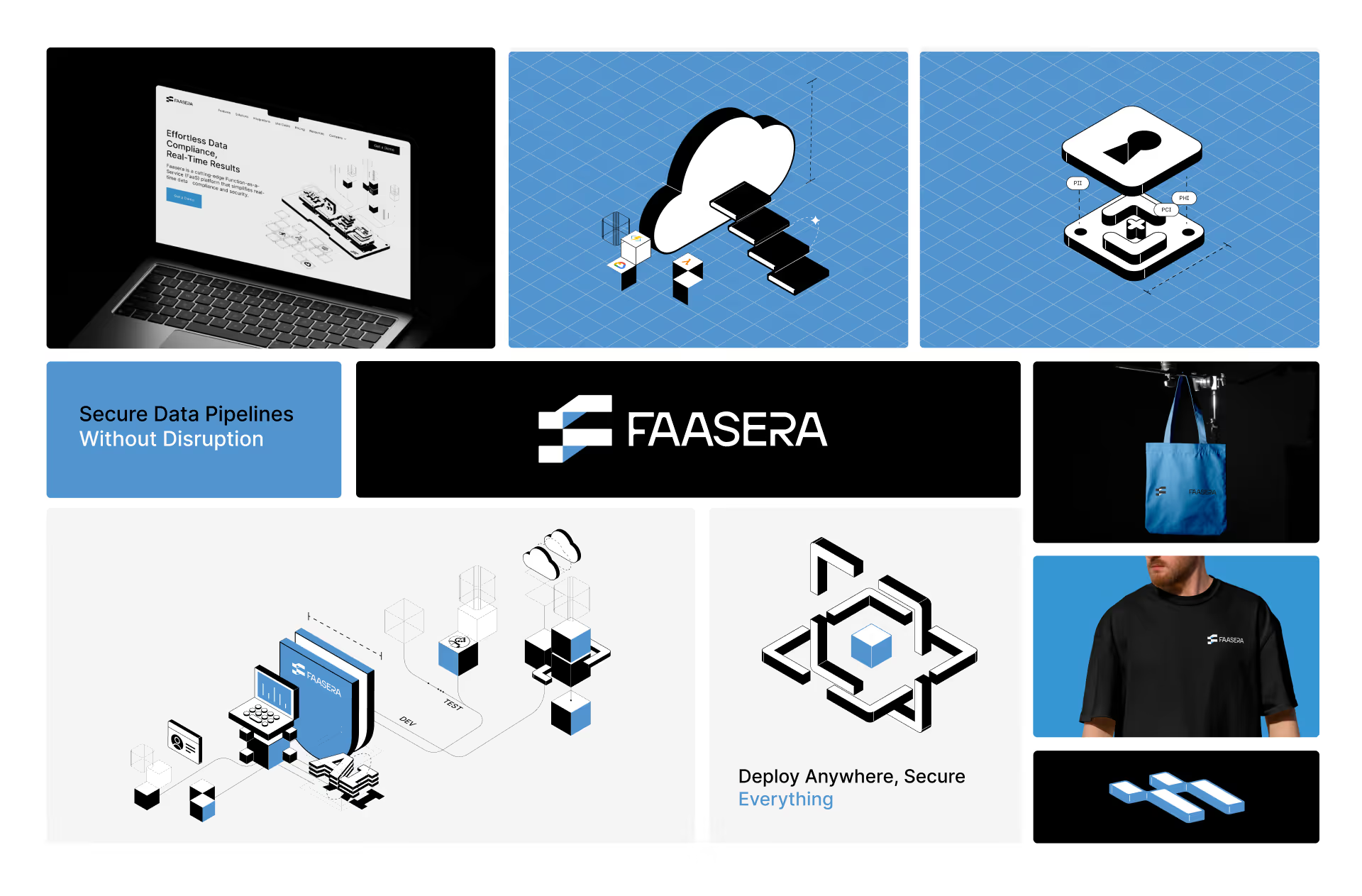
Positioning by Metabrand
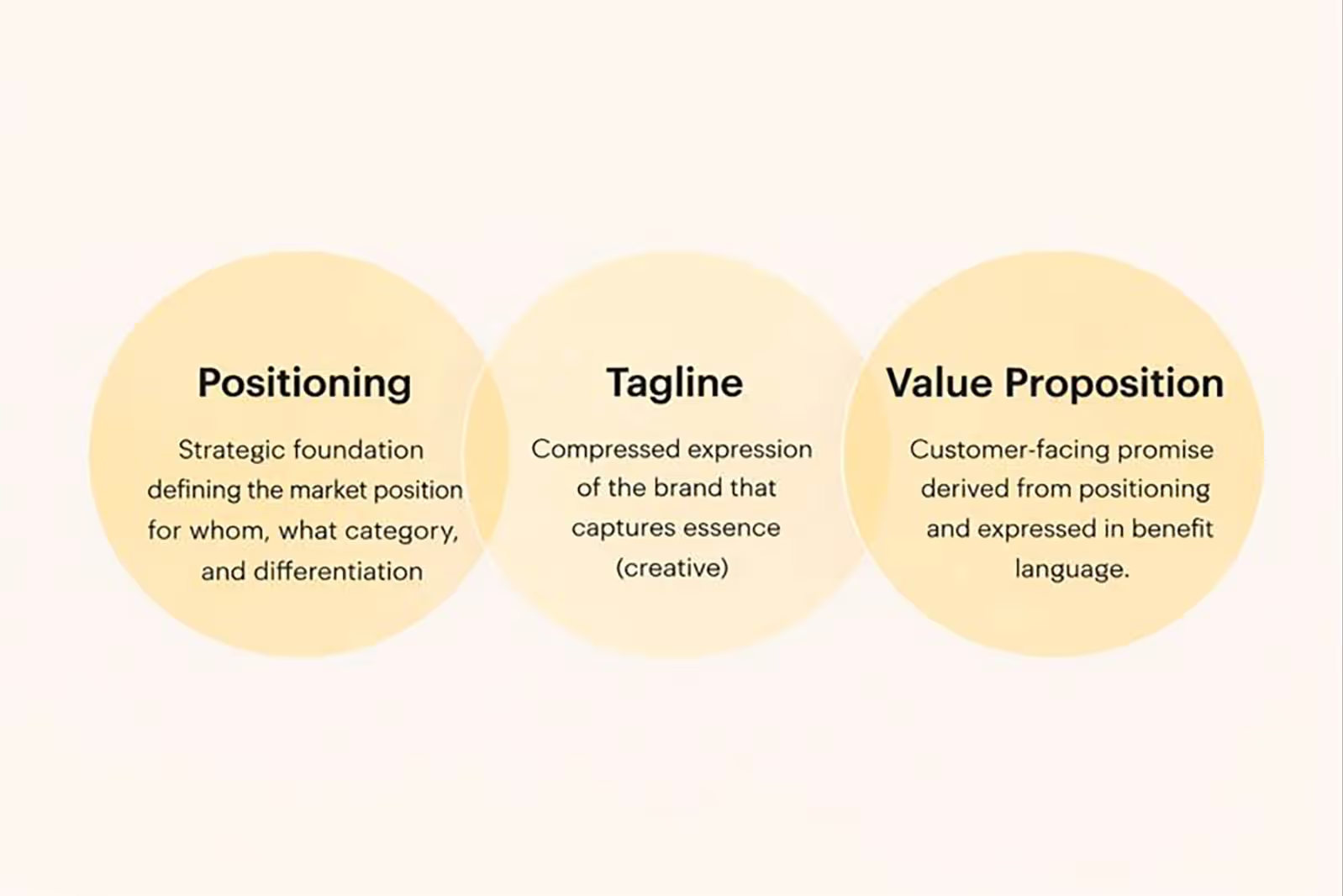
Positioning in Crowded Categories
Most B2B SaaS categories are crowded. CRM has hundreds of options. Project management has hundreds more. How do you position distinctively?
Category Strategy
You have three options:
Lead existing category: Be the best-known option in an established category. Difficult for challengers — category leaders have momentum.
Create subcategory: Own a slice of a larger category. "CRM for real estate" or "project management for engineering teams." Narrow enough to own, large enough to build a business.
Create new category: Define a new space. Gong created "revenue intelligence." Figma created "collaborative interface design." Requires resources to educate market.
For most B2B SaaS startups, subcategorization is the right approach. You inherit category infrastructure (search demand, understood evaluation criteria) while carving out defensible territory.
Positioning Dimensions
Beyond category, position on dimensions where you can credibly differentiate:
For [specific audience]Who [specific need or pain],[Product] is a [category/approach]That [key benefit].Unlike [alternatives],[Product] [key differentiation].
Example — Hypothetical SaaS:
For engineering managers at growing startupsWho waste hours tracking project status across multiple tools,[Product] is an automated project visibility platformThat shows you exactly where every project stands without asking anyone.Unlike traditional project management tools that require constant manual updates,[Product] automatically captures progress from GitHub, Jira, and Slack.
This positioning is:
Specific (engineering managers at growing startups)
Problem-focused (waste hours tracking status)
Differentiated (automatic vs. manual)
Benefit-clear (see where projects stand without asking)
Competitive Positioning
In B2B SaaS, buyers explicitly compare you to alternatives. Your positioning must address this:
Know your competitive set. Who do you compete against in actual deals? Direct competitors, adjacent products, status quo (spreadsheets, manual processes).
Understand their positioning. What do competitors claim? Where are they strong? Where are they weak?
Find defensible territory. What can you claim that competitors cannot credibly claim? Feature-based claims are easily copied. Approach-based or audience-based claims are more defensible.
Don't fight on others' terms. If the category leader owns "comprehensive," don't try to out-comprehensive them. Own something else — "simple," "fast," "specialized."
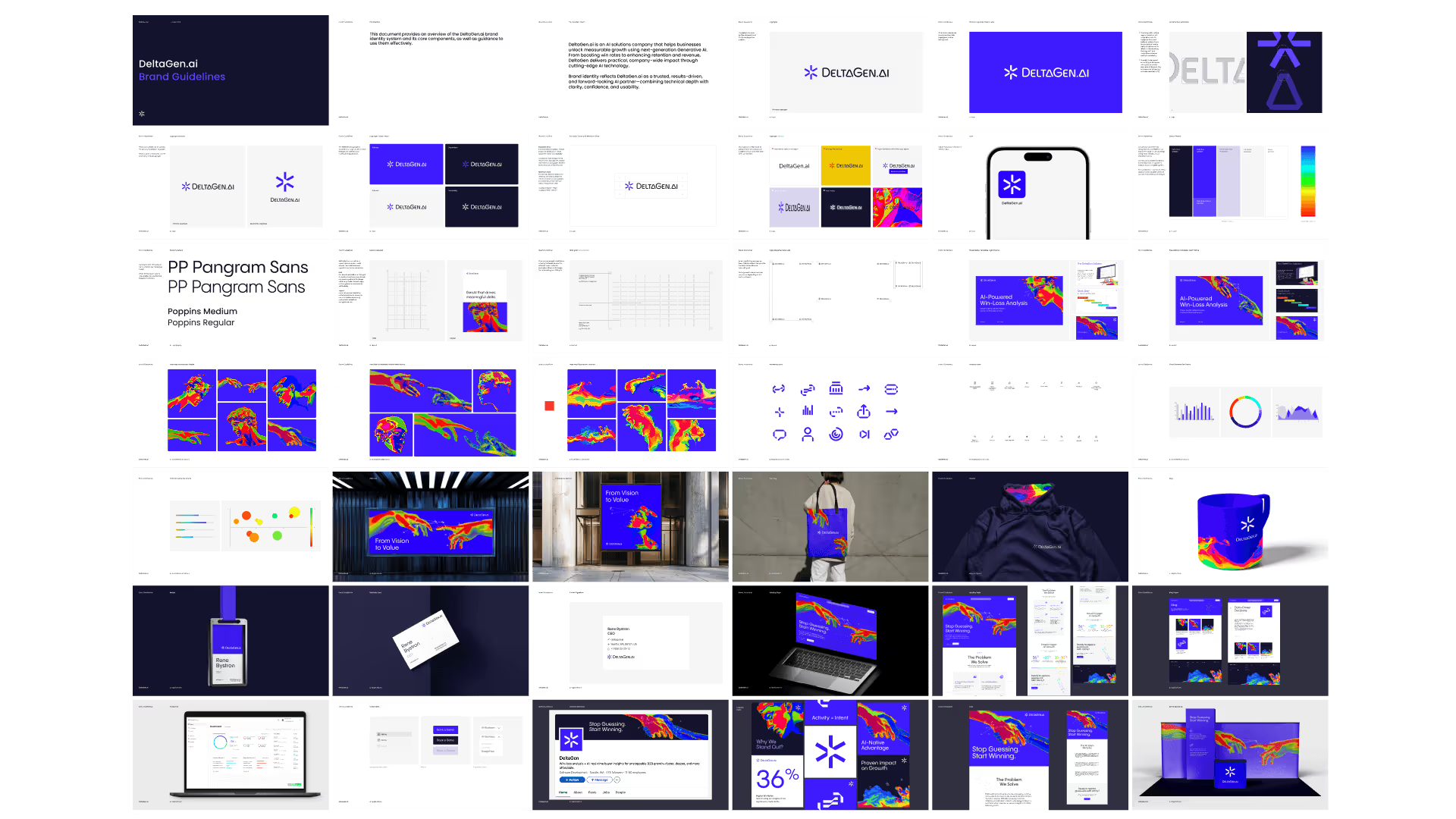
B2B SaaS Brand Guidelines for BDeltagen by Metabrand
The Credibility-Differentiation Tension
Credibility requirements: B2B buyers need to feel safe. Visual identity that's too unusual, playful, or unconventional can trigger risk perception. "This doesn't look like serious software."
Differentiation requirements: But looking exactly like every other SaaS company means you blend into the noise. No distinctiveness, no memorability.
The best B2B SaaS brands navigate this tension — distinctive enough to remember, professional enough to trust.
Category Conventions and Breaking Them
Most B2B SaaS visual identity follows patterns:
Common conventions:
Blue primary color (trust, stability, professionalism)
Conform: Follow conventions to signal category membership. "We look like serious software." Safe, but undifferentiated.
Partially break: Keep some conventions (professional typography, clean layout) while breaking others (unusual color, distinctive illustration style). Balanced approach.
Fully break: Radically different visual approach. High differentiation, higher risk. Requires confidence and strong product.
Color Strategy
Blue: The default. Signals trust, stability, reliability. Overused to the point of meaninglessness in SaaS. If you use blue, differentiate elsewhere.
Green: Growth, success, positivity. Works for productivity, sustainability, health-adjacent tools.
Purple: Creativity, innovation, premium. Less common, more distinctive. Notion, Figma use purple elements.
Orange/Yellow: Energy, warmth, approachability. Stands out but can feel less "enterprise." HubSpot orange works at scale.
Black/Monochrome: Sophistication, simplicity, premium. Linear uses minimal color effectively.
Bold/Unusual: Hot pink, bright red, unexpected combinations. High differentiation, higher risk. Monzo's coral in banking category.
Recommendation: If your product is more conservative (enterprise, security, finance), color may not be where to differentiate. If your product can tolerate more personality, color is powerful differentiation.
Typography Strategy
Geometric sans-serif: Clean, modern, minimal. Inter, SF Pro, Söhne. The SaaS default.
Humanist sans-serif: Slightly warmer, more approachable. Source Sans, Open Sans.
Grotesque: Character and heritage. Grotesk varieties have personality while remaining professional.
Serif (for contrast): Using serif for headlines with sans-serif body can differentiate. Unusual in SaaS, which makes it distinctive.
Custom typography: Maximum differentiation but expensive. Stripe's custom type sets them apart.
Lead with benefit: What outcome do they get?Support with feature: How is that outcome achieved?Prove with evidence: Who else achieved this outcome?
Example:
Benefit: "Know exactly where every project stands"
Feature: "Automatic progress tracking from your existing tools"
Evidence: "Teams using [Product] cut status meetings by 60%"
Don't lead with "AI-powered" or "cloud-based" or feature specs. Those matter, but outcomes matter first.
Proof Points and Specificity
Generic claims are invisible. Specific claims are credible.
Weak: "Trusted by leading companies"Strong: "Trusted by 2,500+ companies including Stripe, Notion, and Figma"
Weak: "Save time with automation"Strong: "Teams save an average of 5 hours per week on manual reporting"
Weak: "Enterprise-grade security"Strong: "SOC 2 Type II certified, GDPR compliant, 99.99% uptime SLA"
Every claim should have specificity or evidence. If you can't back it up, don't say it.
Tone of Voice for B2B SaaS
B2B tone balances professionalism with personality:
Professional but not corporate: Avoid stiff, formal language. But don't be so casual you undermine credibility.
Confident but not arrogant: State what you do clearly. Don't oversell or make claims you can't back.
Clear but not simplistic: Your audience is smart. Don't dumb things down. But don't use jargon as a crutch.
Helpful but not salesy: Educate and inform. Hard selling undermines trust in B2B.
Human but not quirky: Personality is good. Forced quirkiness feels inauthentic.
Spectrum positions for typical B2B SaaS:
Formal ←—●—→ Casual: Slightly casual
Serious ←●——→ Playful: Leaning serious
Technical ←—●—→ Accessible: Middle, adapts to audience
Confident ←●——→ Humble: Confident
Brand Across the SaaS Customer Journey
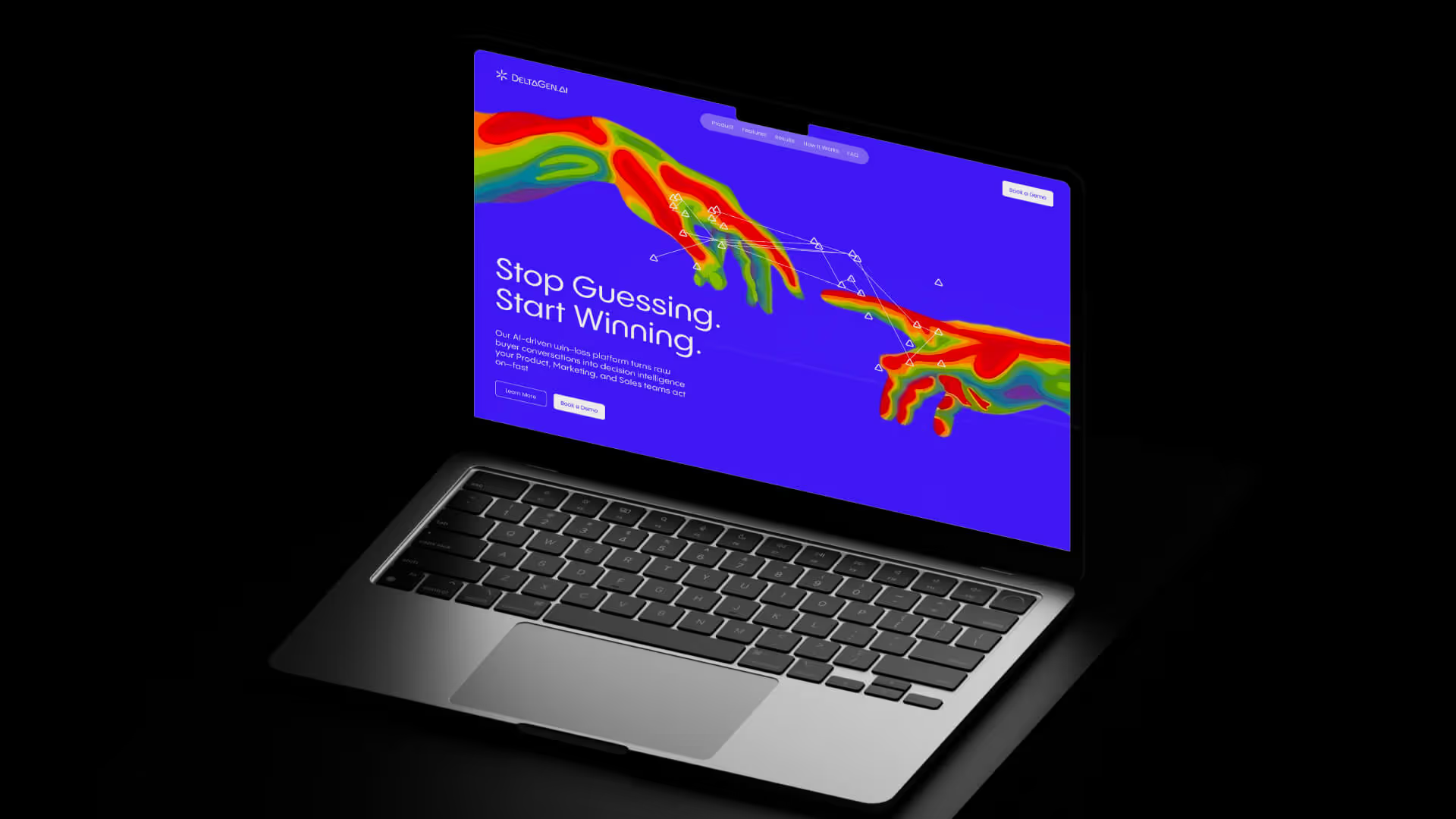
Marketing Website for B2B SaaS by Metabrand
Brand isn't just marketing. In SaaS, brand extends across the entire customer lifecycle.
Awareness Stage
How prospects first encounter you:
Content marketing (blog, guides, resources)
Paid advertising (search, social, display)
Social media presence
Word of mouth and referrals
Review sites (G2, Capterra)
Events and community
Brand role: Create recognition and positive first impression. Communicate what you do and for whom. Stand out from alternatives.
Consideration Stage
Deeper evaluation:
Website exploration
Demo or trial
Sales conversations
Documentation review
Case study and testimonial review
Comparison research
Brand role: Build trust and credibility. Demonstrate understanding of their problems. Prove you can deliver.
Decision Stage
Final selection:
Pricing and proposal
Security and compliance review
Stakeholder alignment
Contract negotiation
Brand role: Reinforce safety of choice. Provide materials for internal champions. Address all stakeholder concerns.
Onboarding Stage
Initial implementation:
Setup and configuration
Training and education
First value realization
Early support interactions
Brand role: Deliver on brand promise. Make first experience match marketing claims. Build confidence in the decision.
Retention and Expansion
Ongoing relationship:
Daily product use
Support interactions
Account management
New feature adoption
Upsell and cross-sell
Renewals
Brand role: Sustain positive experience. Reinforce value continuously. Make expansion feel natural.
Advocacy Stage
Turning customers into promoters:
Reviews and ratings
Referrals
Case study participation
Community engagement
Speaking and evangelism
Brand role: Give advocates stories to tell. Make sharing easy. Reward and recognize champions.
B2B SaaS Brand Case Studies
Stripe: Developer-First Positioning
Stripe built one of the most valuable SaaS brands by making a counterintuitive choice: positioning for developers instead of business buyers.
What they did:
Positioning: "Financial infrastructure for the internet" — positioned as infrastructure, not payment processor. Targeted developers who would integrate and champion.
Visual identity: Clean, distinctive, premium. Purple as secondary color stands out. Custom typography. Minimal illustration. Product and documentation do the talking.
Messaging: Technical excellence communicated through documentation quality, code samples, and developer experience — not marketing speak.
Content:Stripe Press publishes books. Stripe Sessions conference. Atlas guides for startups. Content that provides genuine value.
Why it worked:
Developers don't control payment processor budgets. But they influence decisions and implement solutions. By winning developers, Stripe created bottom-up adoption that expanded into enterprise.
The "infrastructure" framing differentiated from "payment processor" competitors and enabled expansion into lending, banking, and financial services.
Notion: Flexibility as Differentiator
Notion built a distinctive brand in the crowded productivity space.
What they did:
Positioning: "All-in-one workspace" that adapts to how you work — positioned against specialized tools by emphasizing flexibility.
Visual identity: Minimal, clean design with distinctive illustrations. Black and white with accent colors. Custom illustration style that's instantly recognizable.
Messaging: Emphasizes templates, customization, and user-generated content. "Build the tools you need."
Community: Strong template gallery and user community. Users share their setups, creating content and evangelism.
Why it worked:
In a market of specialized tools (note-taking apps, project managers, wikis), Notion's flexibility was genuinely different. The brand communicated this through adaptability metaphors and user stories.
The community-driven approach created authentic advocacy that marketing couldn't buy.
Linear: Speed as Brand
Linear differentiated in issue tracking by making speed central to brand identity.
What they did:
Positioning: "The issue tracking tool you'll enjoy using" — positioned against bloated, slow alternatives (implicitly: Jira).
Visual identity: Minimal, monochromatic design. Focus on the product itself. No illustrations, no decoration. The product is the brand.
Messaging: Speed, speed, speed. "Built for speed." "Keyboard-first." Every message reinforces the core promise.
Product: The product delivers on the brand promise. Actually fast, actually keyboard-optimized. Brand and product are inseparable.
Why it worked:
Engineering teams were genuinely frustrated with slow tools. Linear identified a real pain, made it central to positioning, and delivered a product that matched the promise.
The minimal brand identity reinforces the speed/efficiency positioning — no bloat, no decoration, just function.
HubSpot: Category Creation
HubSpot: Category Creation
HubSpot created the "inbound marketing" category and built brand around it.
What they did:
Category creation: Defined "inbound marketing" as a concept and positioned themselves as the platform for it. Created vocabulary that prospects didn't know they needed.
Content engine: Massive content production — blog, academy, certifications, tools. Established authority in their created category.
Visual identity: Orange stands out in a sea of blue SaaS. Friendly, approachable brand personality.
By creating the category, HubSpot owned the definition. They could position all features in relation to "inbound" — competitors had to argue on HubSpot's terms.
The educational approach built trust and positioned HubSpot as the expert, making them the default choice when prospects were ready to buy.
Building Your B2B SaaS Brand
Step 1: Nail Positioning First
Before visual identity or messaging, answer:
Who specifically are we for?
What problem do we solve better than anyone?
How are we genuinely different?
What category do we compete in (or create)?
If these answers aren't crisp, brand work will lack foundation.
Step 2: Build Trust Signals
Audit your credibility:
What customer logos can we use?
What results can we quantify?
What certifications do we have (or need)?
What credentials does our team have?
What proof points support our claims?
If trust signals are weak, prioritize building them. Brand can't compensate for absence of credibility.
Step 3: Define Distinctive Identity
Based on positioning, develop visual identity that:
Stands out from category conventions
Maintains appropriate professionalism
Works across all touchpoints (marketing, product, sales)
Scales with company growth
Step 4: Create Messaging System
Develop messaging that works for:
Different audiences (technical, business, executive)
Different stages (awareness, consideration, decision)
Different channels (website, sales, product)
Document in framework that enables consistency.
Step 5: Extend to Product
Brand must live in the product:
UI visual language consistent with marketing
Tone of voice consistent in product copy
Onboarding experience matches marketing promises
Support experience reflects brand values
Step 6: Enable the Team
Create resources for:
Marketing team: Guidelines, templates, assets
Sales team: Decks, collateral, talk tracks
Product team: Design system, voice guidelines
Customer success: Communication templates
Everyone who touches customers represents the brand.
Summary: B2B SaaS Brand Principles
Trust is the foundation. Everything you do should build buyer confidence. Credibility signals, social proof, security — these aren't decorations, they're essential.
Differentiation requires courage. Looking like everyone else is safe but invisible. Standing out requires willingness to be different — and conviction to maintain it.
Multiple audiences, consistent brand. Different stakeholders need different emphasis, but the core brand must remain coherent across all touchpoints.
Product is brand. In SaaS, the product experience is the primary brand experience for customers. Marketing and product must be inseparable.
Brand enables growth. Memorability drives referrals. Trust shortens sales cycles. Consistency improves conversion. Brand is a growth lever, not just marketing decoration.
Build for the long term. SaaS relationships span years. Brand equity compounds over time. Invest in brand that lasts.
Frequently Asked Questions
Is branding really important for B2B SaaS companies?
Absolutely. McKinsey research shows B2B companies with strong brands outperform weak-branded competitors by 20%. B2B buyers are actually more emotionally connected to vendors than consumers — because the stakes are higher (career risk). Strong brand shortens sales cycles by pre-establishing trust, enables premium pricing through perceived value, improves win rates in competitive deals, and attracts better talent. In crowded SaaS categories where features converge, brand becomes one of the few sustainable differentiators.
How do I differentiate my SaaS brand when competitors look the same?
Most SaaS companies default to the same visual patterns (blue, geometric sans-serif, abstract illustrations) and messaging patterns ("streamline," "optimize," "transform"). Differentiation requires courage to break conventions. Options: distinctive color outside the blue default, strong point of view in messaging, clear audience specialization (own a segment completely), unusual visual approach, or personality that stands out. Study brands that differentiate successfully — Linear's speed focus, Notion's flexibility positioning, Superhuman's premium feel — and note that their differentiation is strategic, not just aesthetic.
How do I build brand for multiple stakeholders in B2B sales?
B2B purchases involve 6-10 decision-makers on average, each with different concerns. Build a messaging system with shared foundation and audience-specific emphasis. Technical evaluators need capability and architecture details. Business buyers need outcomes and ROI. Executives need strategic alignment and risk mitigation. Procurement needs security and compliance. Create content and touchpoints for each audience while maintaining consistent core positioning and visual identity. The brand is one brand; how you express it flexes by audience.
Build Your B2B SaaS Brand
If you're building a B2B SaaS company and need brand that differentiates, builds trust, and enables growth — we can help.
Metabrand specializes in branding for B2B SaaS and technology companies. We understand the unique dynamics of SaaS — multiple stakeholders, long sales cycles, product-led growth — and build brands that work across the entire customer journey.