By clicking "Accept all cookies", you agree to storing cookies on your device to enhance site navigation, analyze site usage and assist in our marketing efforts as outlined in our privacy policy.
By clicking 'Accept all cookies', you agree to storing cookies on your device to enhance site navigation, analyze site usage and assist in our marketing efforts as outlined in our privacy policy.
Your startup's name is the first piece of brand most people encounter. It appears in pitch decks, on business cards, in app stores, on legal documents, in press coverage, and in every customer conversation.
A great name doesn't guarantee success. But a bad name creates friction at every turn — harder to remember, harder to spell, harder to find, harder to take seriously.
"If you have a US startup called X and you don't have x.com, you should probably change your name. The problem with not having the .com of your name is that it signals weakness." — Paul Graham
The data supports this. According to Graham's analysis: 100% of the top 20 YC companies by valuation have their .com domain. 94% of the top 50.
Names stick. Graham warns:
"Whatever name you choose, be careful. Names stick. You need a way to refer to things, and whatever you call something rapidly becomes its name."— Paul Graham
Changing a name later is expensive — legally, operationally, and in accumulated brand equity. Better to get it right from the start.
This guide covers:
What makes a name work (and what doesn't)
The six types of startup names
Step-by-step naming process
Domain and trademark strategy
Tools and resources
Real examples and case studies
When to hire naming specialists
Let's find the right name.
What Makes a Great Startup Name
Before generating options, understand what you're optimizing for.
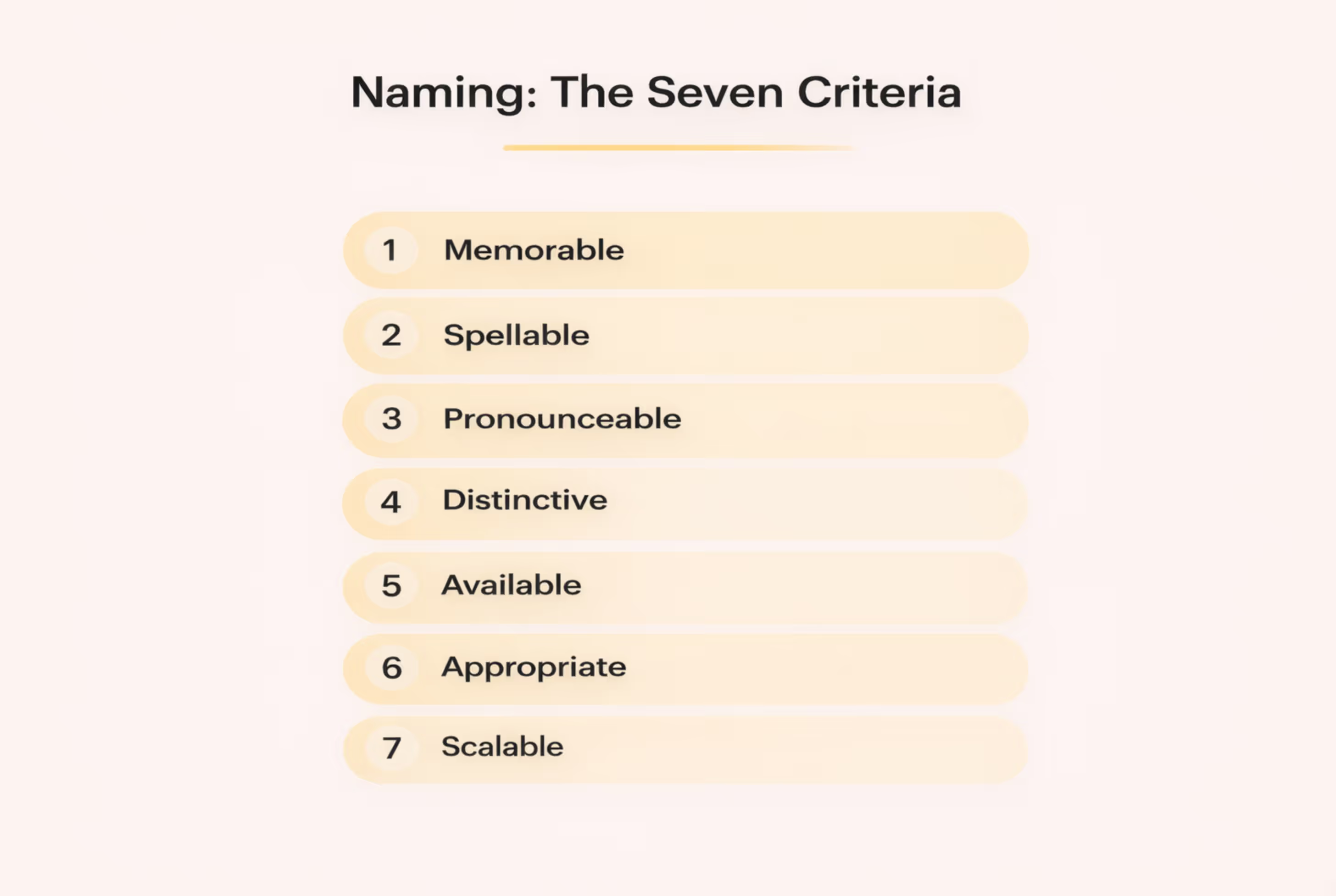
Naming: The Seven Criteria by Metabrand
The Seven Criteria
Strong startup names share common characteristics:
1. Memorable
The name sticks after one exposure. People can recall it hours or days later without prompting.
Memorability comes from:
Distinctiveness (stands out from category)
Simplicity (easy to hold in mind)
Sound patterns (rhythm, alliteration, rhyme)
Meaning or story (conceptual hook)
Test: Tell someone the name once. Ask them tomorrow. Do they remember?
2. Spellable
People can write the name correctly after hearing it. No ambiguous spellings, unusual letter combinations, or phonetic confusion.
Problem names: Lyft (Lift?), Kaggle (Cagle? Kagle?), Fiverr (Fiver? Fiverr?)
Clean names: Stripe, Notion, Linear, Figma, Slack
Test: Say the name aloud. Can someone type it correctly into a browser?
3. Pronounceable
People can say the name correctly after reading it. No ambiguous pronunciations, unfamiliar letter combinations, or linguistic traps.
Problem names: Huawei, Xiaomi, Nguyen (for non-native speakers)
Clean names: Apple, Google, Amazon, Stripe
Test: Show the name to someone who's never seen it. Do they pronounce it correctly?
4. Distinctive
The name stands out from competitors and category conventions. It doesn't blend into the sea of similar-sounding options.
If your category is full of names ending in "-ly" or "-ify," a different pattern differentiates. If everyone uses abstract tech words, a concrete word stands out.
Test: List the name alongside five competitors. Does it stand out or blend in?
5. Available
The name can actually be used:
Domain available (ideally .com)
Trademark clearable in relevant jurisdictions
Social handles available (or acquirable)
No problematic existing associations
Availability is non-negotiable. A perfect name you can't use is worthless.
Test: Check USPTO, domain registrars, and social platforms before falling in love.
6. Appropriate
The name fits your category, audience, and positioning. A playful consumer brand can use a playful name. An enterprise security company probably shouldn't.
Appropriateness isn't about being boring — it's about fit. Slack works for a workplace tool because it subverts expectations cleverly. "Slack" for a hospital management system would feel wrong.
Test: Does the name feel right for your positioning and audience?
7. Scalable
The name accommodates growth. It doesn't lock you into a specific product, market, or geography that you might outgrow.
Amazon started as a bookstore but chose a name that could encompass everything. Pets.com chose a name that trapped them in one category.
Test: If you expand to new products or markets, does the name still work?
The Hierarchy of Name Quality
Paul Graham offers a useful ranking:
"The best kind of names are the ones that are both cool words and refer to what the company does. The second grade of names are merely cool words. The next grade of names are ones that are mediocre but not actively repulsive."— Paul Graham
Aim for the first tier. Accept the second tier if necessary. Avoid the third.
The Six Types of Startup Names
Names fall into categories, each with strengths and weaknesses.
Best for: Startups who can find an evocative word that suggests their positioning without describing it literally.
This is the most common approach for successful tech startups. Stripe suggests clean lines (like the stripes in payment rails). Notion suggests ideas and concepts. Slack subverts the word's negative connotation cleverly.
Best for: Established companies evolving away from descriptive names. Rarely a good choice for startups — you don't have the brand equity to make random letters meaningful.
Hybrid Approaches
Many successful names combine types:
PayPal: Descriptive (Pay) + invented (Pal as word choice)
Facebook: Compound of real words
YouTube: Real word (Tube as slang for TV) + second person reference
Instagram: Instant + telegram
Pinterest: Pin + interest
Snapchat: Snap + chat
Netflix: Net + flicks (slang for movies)
Compound and portmanteau names can capture the best of multiple approaches.
The Naming Process: Step by Step
Naming isn't a brainstorm. It's a rigorous process that balances creativity with practical constraints.
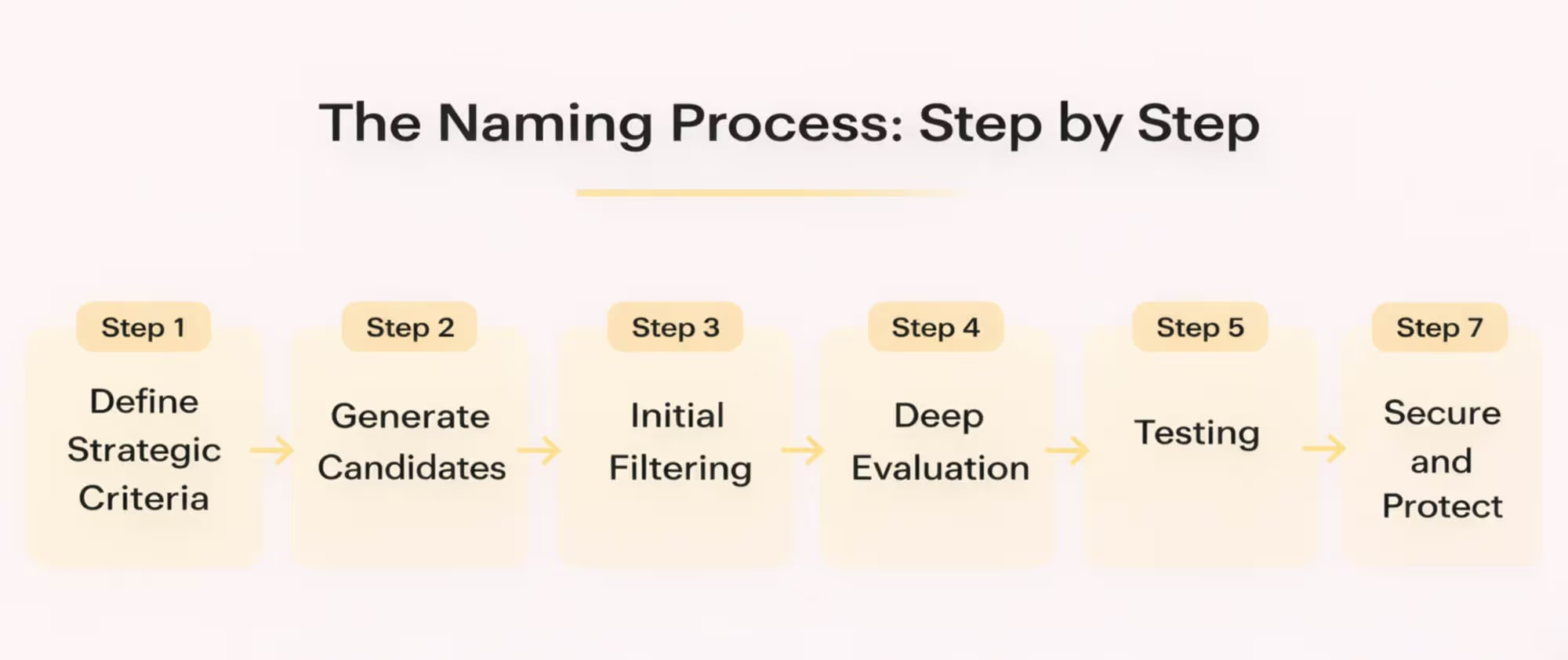
Naming Process by Metabrand
Step 1: Define Strategic Criteria
Before generating names, define what you need:
Positioning inputs:
Target customer
Category
Key differentiation
Brand personality
Practical constraints:
Must have .com (or acceptable alternative)
Must be trademarkable in [jurisdictions]
Must work in [languages/cultures]
Character limit: [if relevant for URLs, app names]
Tone/style direction:
Real word vs. invented
Literal vs. abstract
Serious vs. playful
Short vs. longer
Words/themes to explore:
[List of semantic territories]
Words/themes to avoid:
[Competitor names, problematic associations]
This brief guides all creative work and evaluation.
Step 2: Generate Candidates
Cast a wide net. Quality comes from quantity — expect to generate 200-500 candidates before finding strong finalists.
Generation techniques:
Brainstorming: List words associated with your product, benefit, category, metaphors, emotions, audience.
Thesaurus exploration: For each promising word, explore synonyms, antonyms, and related terms.
Etymology research: Trace word origins. Latin, Greek, and other roots often yield interesting options.
Compound creation: Combine words, word parts, and morphemes in new ways.
Portmanteau construction: Blend two words (Instagram = instant + telegram).
Foreign language mining: Explore translations of key concepts. Spanish, Italian, Latin, Japanese often yield interesting options.
Don't decide in a conference room. Test with real people.
Internal testing:
Present to team without revealing favorites
Gauge reactions, memorability, pronunciation
Listen for concerns you hadn't considered
External testing:
Show to target customers
Test in realistic contexts (mock website, email signature)
Measure recall after delay
Stress testing:
Say it 50 times. Does it wear well?
Put it in a sentence. Does it work grammatically?
Imagine it on a billboard, app icon, legal document
Consider it in 5 years. Does it still work?
Step 6: Final Selection
With test feedback, make the call:
Decision criteria:
Which name tested best with target audience?
Which is most available (domain, trademark)?
Which best supports positioning?
Which has strongest long-term potential?
Decision process:
Small team (2-3 people) makes final call
Gather input broadly, decide narrowly
Don't design by committee — someone has to choose
Commitment:
Once decided, commit fully
Second-guessing undermines the name
Names become "right" through committed use
Step 7: Secure and Protect
Before announcing, lock down the name:
Domain:
Purchase .com and key alternatives
Purchase common misspellings
Consider country-code TLDs for key markets
Trademark:
File trademark application in priority jurisdictions
Consider international filing (Madrid Protocol)
Work with trademark attorney for proper classification
Social handles:
Secure handles on major platforms
Document any handles you couldn't get
Plan for handle acquisition if needed
Corporate entity:
Register business entity with new name
Update legal documents
Plan for any necessary transitions
Domain Strategy
Domain is critical for startups. It affects discoverability, credibility, and operational efficiency.
The .com Imperative
Paul Graham's advice is clear:
"If you have a US startup called X and you don't have x.com, you should probably change your name. The problem with not having the .com of your name is that it signals weakness."— Paul Graham
The data backs this up. Nearly all successful YC companies have their .com. It signals legitimacy, resources, and long-term thinking.
When Alternative TLDs Work
That said, alternatives can work in specific contexts:
.io: Accepted in tech/developer communities. GitHub, Socket.io. Developer tools can use .io without credibility loss.
.co: Somewhat accepted as .com alternative. Twitter.co (for link shortening), Plasso.co. Some consumer acceptance.
.ai: Increasingly common for AI companies. Jasper.ai, Copy.ai. Category-appropriate.
Country codes: Work when market is country-specific. .de for Germany, .co.uk for UK. But limit global perception.
Budget: $200-$500 for contest; marketplace names vary.
Independent naming consultants:
Experienced practitioners working independently
Often former agency namers
More accessible budget than top agencies
Quality varies significantly
Budget: $5K-$25K typical.
What You Get from Professional Naming
Research phase:
Strategic brief development
Competitive landscape analysis
Linguistic and cultural screening protocols
Generation phase:
Hundreds of candidates from trained namers
Multiple creative directions explored
Experienced pattern recognition for what works
Evaluation phase:
Professional linguistic screening
International cultural vetting
Trademark pre-screening
Deliverables:
Shortlist of viable, vetted candidates
Rationale and positioning for each
Preliminary trademark assessment
Domain availability analysis
The value isn't just creativity — it's avoiding expensive mistakes. Professional namers have seen thousands of naming projects and know what pitfalls to avoid.
Naming Tools and Resources
Name Generators
Namelix — AI-powered generator. Enter keywords, get branded name suggestions with logos. Good for initial exploration.
Squadhelp — Crowdsourced naming contests plus curated marketplace of pre-vetted names.
Wordoid — Creates made-up words based on language patterns. Useful for invented names.
Panabee — Name search with domain availability checking. Shows related ideas.
LeanDomainSearch — Pairs your keyword with other words, shows only available .com domains.
Bust a Name — Combines words, checks domain availability.
Google Translate — Check meanings in other languages (with caution).
Common Naming Mistakes
Mistake 1: Falling in Love Before Checking Availability
Founders generate the "perfect" name, tell everyone, print business cards — then discover the trademark is taken or domain is $500K.
Fix: Check availability before emotional attachment. Preliminary screens first, deep evaluation before commitment.
Mistake 2: Descriptive Names That Can't Be Protected
"CloudSync Solutions" or "DataFlow Analytics" — descriptive names that are impossible to trademark and indistinguishable from competitors.
Fix: Aim for suggestive, arbitrary, or fanciful marks. Descriptive names are legally weak and competitively generic.
Mistake 3: Clever Names That Don't Travel
Puns, cultural references, or wordplay that work in English but confuse international audiences or have unfortunate meanings elsewhere.
Fix: Screen names in target market languages. Test pronunciation with non-native speakers. Avoid culture-specific references if you'll go global.
Mistake 4: Names That Are Hard to Use
Names that are awkward in sentences, hard to verb, or don't work as file names, email domains, or app store entries.
Fix: Stress test names in realistic contexts. Put them in emails, URLs, conversation. Identify friction before committing.
Mistake 5: Naming by Committee
Trying to find a name that satisfies all stakeholders produces bland compromise.
Fix: Gather input broadly, decide narrowly. Small group (2-3 people) makes final call. Stakeholder veto power kills good names.
Mistake 6: Choosing What's Available Over What's Right
Settling for a weak name because the .com is available, rather than finding a strong name and investing in the domain.
Fix: Budget for domain acquisition. A $10K-$50K domain for a strong name beats a free domain for a weak name.
Mistake 7: Analysis Paralysis
Endless evaluation, never committing. Every name has flaws if you look hard enough.
Fix: Set a deadline. Define decision criteria. Accept that no name is perfect. Commitment makes names work.
Naming Checklist
Before finalizing your name, verify:
☐ Memorable. People recall it after one exposure.
☐ Spellable. People can type it correctly after hearing it.
☐ Pronounceable. People can say it correctly after reading it.
☐ Distinctive. It stands out from competitors.
☐ Appropriate. It fits your category and positioning.
☐ Scalable. It works as you grow to new products/markets.
☐ Domain available. .com is secured (or acceptable alternative).
☐ Trademark clearable. No blocking conflicts in relevant classes.
☐ Socially available. Key handles secured or plan in place.
☐ Linguistically safe. No problematic meanings in target languages.
☐ Stakeholder aligned. Decision-makers are committed.
☐ Legally protected. Trademark application filed.
Summary: Names Are Forever
Your startup's name will appear billions of times over the company's life — in conversations, on screens, in documents, in memories. It deserves serious attention.
The good news: naming has a process. Follow the steps, apply the criteria, check availability, test with real people, and commit. You'll find a name that works.
The names that seem inevitable today — Google, Amazon, Stripe, Slack, Airbnb — all felt like risky choices when they were made. They became "right" through committed use and brand building.
Your name will too.
Frequently Asked Questions
How important is having a .com domain for my startup name?
Very important, especially for B2B and enterprise-focused startups. Paul Graham's analysis of Y Combinator's top companies found that 100% of the top 20 and 94% of the top 50 have their exact name .com. A .com signals legitimacy, is easier to remember, and avoids confusion. That said, some alternatives work in specific contexts: .io for developer tools, .ai for AI companies, country codes for local businesses. If you can't afford the ideal .com, consider whether a different name with an available .com might serve you better long-term.
Should I hire a naming agency or do it myself?
It depends on your budget and the stakes. Professional naming firms bring systematic processes, trademark expertise, and creative breadth — they'll generate hundreds of candidates and handle legal screening. This matters most for funded startups where a naming mistake is expensive to fix. For bootstrapped companies or less critical naming needs (feature names, product tiers), a rigorous internal process can work. Key regardless of approach: never fall in love with a name before checking trademark and domain availability.
What makes a startup name memorable?
Memorable names share several characteristics: they're short (ideally under 3 syllables), easy to spell after hearing once, easy to pronounce correctly on first read, and distinctive enough to stand out from competitors. The best names often have some element of unexpectedness — a real word used in an unusual context (Apple, Slack), an invented word with pleasant sounds (Spotify, Zillow), or a compound that creates new meaning (Facebook, YouTube). Avoid generic descriptive names that blur together with competitors.
Need Naming Help?
If you're launching a startup, rebranding, or struggling to find a name that works — we can help.
Metabrand offers naming services for tech startups, from strategic brief through trademark filing. We combine creative exploration with rigorous screening to find names that are distinctive, available, and built to last.