By clicking "Accept all cookies", you agree to storing cookies on your device to enhance site navigation, analyze site usage and assist in our marketing efforts as outlined in our privacy policy.
By clicking 'Accept all cookies', you agree to storing cookies on your device to enhance site navigation, analyze site usage and assist in our marketing efforts as outlined in our privacy policy.
The Gap Between What You Do and What Customers Hear
You've nailed your positioning. You know who you're for, what category you own, and why you're different.
Now comes the hard part: making other people understand it.
This is where most startups fail. Not because their positioning is wrong, but because their messaging doesn't land. They describe features instead of outcomes. They use internal jargon instead of customer language. They try to say everything instead of saying one thing clearly.
The result: prospects visit the website, read the copy, and leave confused. Investors hear the pitch and can't repeat what the company does. Sales calls end with "that sounds interesting" instead of "let's move forward."
Messaging is the bridge between positioning and perception. It translates strategic clarity into language that makes customers act.
Stripe describes itself in seven words: "Financial infrastructure for the internet." Notion claims: "One workspace. Every team." Linear leads with: "Linear is a purpose-built tool for planning and building products."
These aren't accidents. They're the result of rigorous messaging work — understanding what matters to customers, how they talk about their problems, and what language triggers action.
This guide covers:
What a messaging framework actually includes
The hierarchy from value proposition to proof points
How to find the language your customers actually use
Tone of voice and how to define it
Frameworks for different contexts (website, sales, pitch deck)
How to test and iterate messaging
Templates you can use today
Let's build the bridge.
What Is a Messaging Framework?
A messaging framework is the documented system for how your company communicates. It ensures everyone — from marketing to sales to customer success to executives — tells the same story in the same way.
Without a framework, messaging fragments. Marketing says one thing on the website. Sales says something different on calls. The CEO tells a third version to investors. Customers receive inconsistent signals and trust erodes.
With a framework, the entire organization speaks with one voice. Not robotically — the framework provides principles and building blocks, not scripts. But consistently, coherently, and strategically.
Messaging Framework by Metabrand
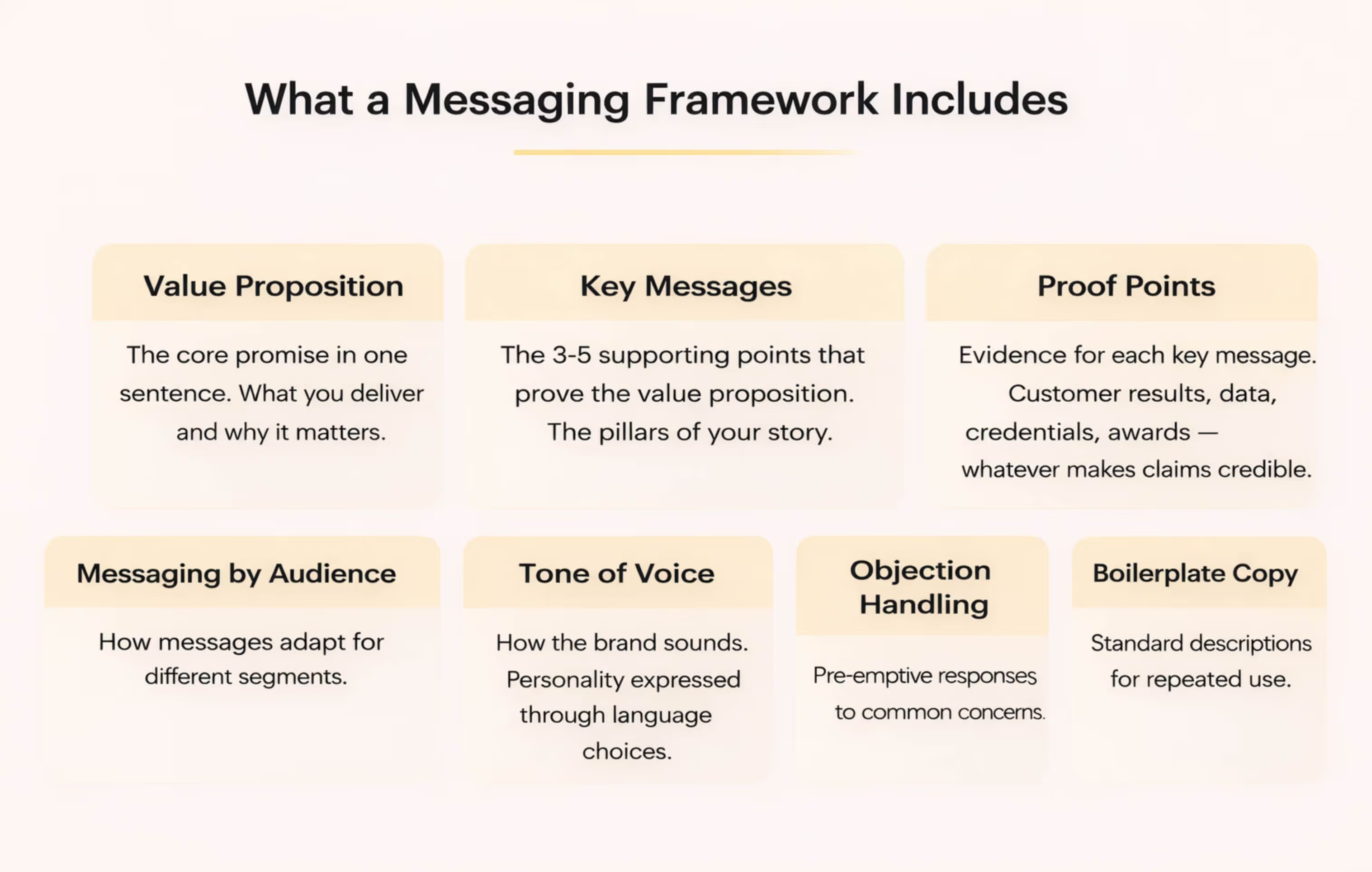
What a Messaging Framework Includes
A complete messaging framework contains:
Value Proposition: The core promise in one sentence. What you deliver and why it matters.
Key Messages: The 3-5 supporting points that prove the value proposition. The pillars of your story.
Proof Points: Evidence for each key message. Customer results, data, credentials, awards — whatever makes claims credible.
Messaging by Audience: How messages adapt for different segments. Technical buyers hear different emphasis than business buyers.
Tone of Voice: How the brand sounds. Personality expressed through language choices.
Objection Handling: Pre-emptive responses to common concerns. Pricing, competition, switching costs.
Boilerplate Copy: Standard descriptions for repeated use. About us, product descriptions, founder bios.
This document becomes the source of truth. Every piece of communication — website copy, sales decks, email campaigns, PR quotes — draws from it.
The Messaging Hierarchy
Effective messaging operates at multiple levels, from broad positioning down to specific proof points. Think of it as a pyramid:
Each level supports the one above. Proof points validate supporting points. Supporting points explain key messages. Key messages prove the value proposition. Everything ladders up.
Level 1: Value Proposition
The value proposition is your core promise compressed into one sentence. It answers: what do you do, for whom, and why does it matter?
Characteristics of strong value propositions:
Specific: Names the outcome, not vague improvement
Differentiated: Couldn't be said by competitors
Benefit-focused: Emphasizes outcome, not feature
Memorable: Simple enough to repeat
Examples:
Stripe: "Financial infrastructure for the internet"
Slack: "Where work happens"
Figma: "The collaborative interface design tool"
Notion: "One workspace. Every team."
Linear: "The issue tracking tool you'll enjoy using"
Superhuman: "The fastest email experience ever made"
Notice the pattern: each names a specific outcome or position. Not "we help businesses" but "financial infrastructure for the internet." Not "team communication" but "where work happens."
The value proposition formula:
Several formulas help structure value propositions:
Formula 1: [Outcome] for [Audience]
"Financial infrastructure for the internet" (Stripe)
"The fastest email experience ever made" (Superhuman)
Formula 2: [What you do] that [key benefit]
"Issue tracking tool you'll enjoy using" (Linear)
"Collaborative design tool that keeps everyone in sync" (hypothetical)
Formula 3: [Category reimagined]
"Banking for startups" (Mercury)
"CRM for founders who hate CRM" (hypothetical)
The right formula depends on whether you're emphasizing outcome, benefit, audience, or category disruption. Test multiple approaches.
Level 2: Key Messages
Key messages are the 3-5 pillars that support and prove your value proposition. Each message should:
Stand alone as a complete thought
Support the value proposition
Be distinct from other key messages
Have evidence behind it
Why 3-5?
Cognitive research suggests people retain 3-5 items in working memory. More messages dilute impact. Fewer feel incomplete.
Example: Hypothetical SaaS Company
Value Proposition: "Customer onboarding that reduces time-to-value by 60%"
Key Messages:
Guided workflows replace guesswork. Step-by-step onboarding paths ensure no customer gets stuck or lost.
See exactly where customers drop off. Real-time analytics reveal friction points so you can fix them before churn.
Launch in hours, not months. No-code builder means your team ships onboarding experiences without engineering resources.
Personalize at scale. Segment-based experiences deliver relevant onboarding for every customer type.
Each message supports "reduces time-to-value" from a different angle: guidance, visibility, speed, personalization. Together, they paint a complete picture.
Level 3: Supporting Points
Supporting points add detail to each key message. They answer "how?" and "what specifically?"
For Key Message 1: "Guided workflows replace guesswork"
Supporting points:
Interactive checklists show customers exactly what to do next
These aren't claims — they're specific mechanisms that make the claim credible.
Level 4: Proof Points
Proof points provide evidence. They transform messaging from assertion to demonstration.
Types of proof points:
Customer results: "Customers see 60% faster time-to-value" (with named customer if possible)
Data: "10,000+ onboarding flows launched last quarter"
Credentials: "Built by former Intercom and Amplitude engineers"
Awards/Recognition: "Named #1 in G2's Onboarding category"
Customer logos: Social proof through recognizable brands
Testimonials: Direct quotes from satisfied customers
Case studies: Detailed stories of customer success
Proof points should be specific and verifiable. "Customers love us" isn't proof. "Customers report 60% faster onboarding (based on survey of 200+ accounts)" is proof.
Finding Customer Language
The biggest messaging mistake: using your language instead of theirs.
Internally, you might describe your product as "an AI-powered predictive analytics platform with real-time data orchestration capabilities." Customers describe their problem as "I can't figure out what's happening until it's too late."
Effective messaging uses customer language — the words, phrases, and framings that exist in their heads before they encounter your brand.
How to Discover Customer Language
1. Customer Interviews
The richest source of language. Ask open-ended questions:
"How would you describe the problem you were trying to solve?"
"What were you doing before you found us?"
"How would you explain what we do to a colleague?"
"What almost stopped you from buying?"
Listen for exact phrases. When a customer says "I was drowning in spreadsheets," that's messaging gold — far better than "manual process inefficiencies."
2. Sales Call Analysis
Record and transcribe sales calls (with permission). Look for:
How prospects describe their situation
What questions they ask
What objections they raise
What language makes them lean in
Tools like Gong, Chorus, or simple transcription reveal patterns across dozens of conversations.
3. Review Mining
If you have reviews on G2, Capterra, Trustpilot, or app stores, analyze them systematically:
What benefits do customers mention most?
What language do they use repeatedly?
What do they compare you to?
What would they tell others?
Also analyze competitor reviews — you'll find language for problems your target customers are trying to solve.
4. Support Ticket Analysis
Support conversations reveal:
How customers describe what they're trying to do
What confuses them
What language they use vs. your documentation
Gaps between their language and your language indicate messaging opportunities.
5. Search Query Analysis
What are people typing into Google? Tools like Ahrefs, SEMrush, or even Google's autocomplete reveal:
How people describe problems
What questions they ask
What category terms they use
If your positioning says "workflow automation platform" but customers search "how to stop wasting time on repetitive tasks," adjust your messaging accordingly.
The Language Translation Exercise
For each key message, create a translation table:
Internal LanguageCustomer LanguageAI-powered predictive analyticsSee problems before they happenReal-time data orchestrationEverything updates automaticallySeamless integration capabilitiesWorks with your existing toolsEnterprise-grade securityYour data is protectedIntuitive user interfaceEasy to use from day one
Use the right column in customer-facing messaging. Save the left column for technical documentation.
Tone of Voice
Tone of voice is how your brand sounds — the personality expressed through language choices. Two companies can say the same thing in completely different ways:
Formal: "Our platform enables organizations to streamline operational workflows."
Casual: "We help teams get stuff done faster."
Playful: "Say goodbye to busywork. You've got better things to do."
Technical: "Reduce cycle time with automated workflow orchestration across integrated systems."
Same underlying message. Entirely different tone.
Defining Your Tone
Tone should align with:
Brand personality: How would your brand behave if it were a person?
Audience expectations: What tone do your customers expect and trust?
Category norms: Does your category demand formality or allow casualness?
Differentiation: Can tone itself be a differentiator?
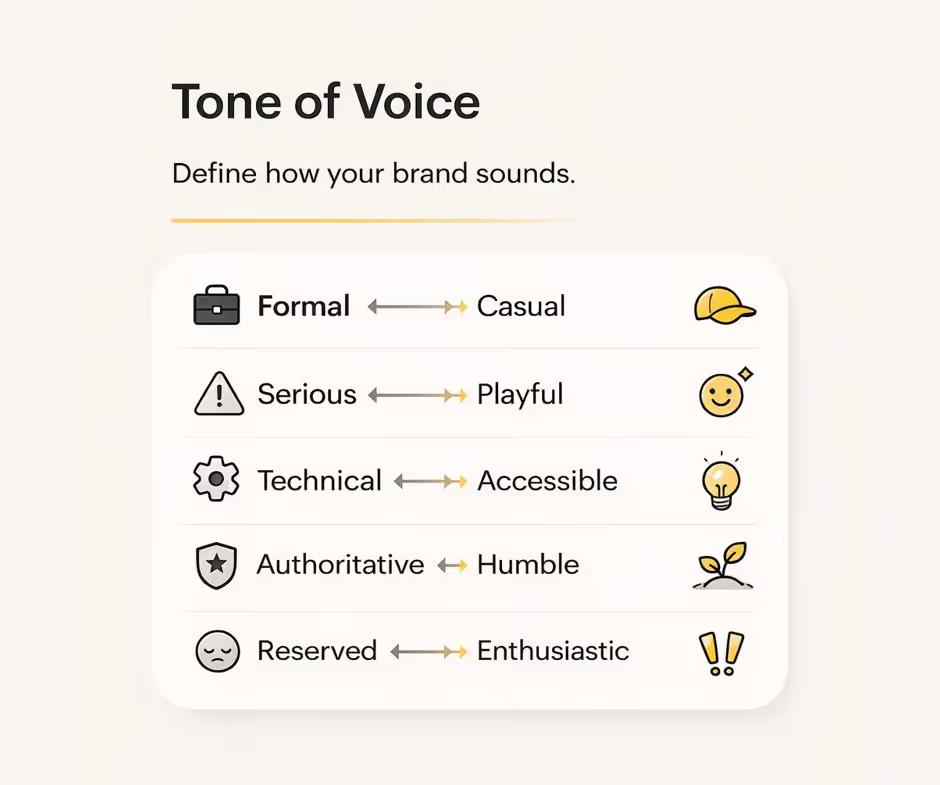
The Tone Dimensions
Define tone along spectrums:
Formal ←→ Casual
Formal: Complete sentences, proper grammar, no contractions
Donald Miller's StoryBrand framework, from Building a StoryBrand, offers a narrative approach to messaging. The core insight: your customer is the hero, not your brand. Your brand is the guide.
The Seven-Part Story Structure
1. A Character (Your Customer)
Who are they?
What do they want?
2. Has a Problem
External problem (practical)
Internal problem (emotional)
Philosophical problem (why it's wrong)
3. And Meets a Guide (Your Brand)
Empathy: You understand their struggle
Authority: You know how to solve it
4. Who Gives Them a Plan
Process plan: Simple steps to success
Agreement plan: Reduce risk/fear
5. And Calls Them to Action
Direct CTA: Buy now, sign up, schedule
Transitional CTA: Download guide, watch demo
6. That Helps Them Avoid Failure
What's at stake?
What happens if they don't act?
7. And Ends in Success
What does success look like?
How will they feel?
Applying StoryBrand
Example: Project Management SaaS
1. Character: Marketing team leader managing complex campaigns
2. Problem:
External: Projects fall behind, deadlines missed
Internal: Feels overwhelmed, losing control
Philosophical: Good work shouldn't be this chaotic
3. Guide:
Empathy: "Managing campaigns across channels is chaos. We get it."
Authority: "We've helped 5,000+ teams ship on time."
4. Plan:
Step 1: Import your projects (5 minutes)
Step 2: See everything in one view
Step 3: Hit every deadline
5. CTA:
Direct: "Start Free Trial"
Transitional: "See the 2-Minute Demo"
6. Failure:
Missed deadlines, budget overruns, stressed team, career risk
7. Success:
Campaigns launch on time, team has clarity, leader feels in control
This framework ensures messaging centers on customer transformation, not product features.
Objection Handling
Every prospect has objections. Effective messaging addresses them before they become blockers.
☐ Value proposition is clear. Anyone can understand what you do and why it matters.
☐ Key messages are distinct. Each pillar covers different ground.
☐ Proof points are specific. Claims are backed by evidence.
☐ Language matches customers. You use their words, not yours.
☐ Tone is documented. Guidelines exist for how to sound.
☐ Audiences are addressed. Different segments get appropriate emphasis.
☐ Objections are handled. Common concerns have prepared responses.
☐ Framework is shared. Sales, marketing, and leadership are aligned.
☐ Messaging is tested. Real customers have validated resonance.
☐ Iteration is planned. Process exists to improve over time.
Messaging is the bridge between positioning and perception. Build it carefully, and everything your company says will work harder.
Frequently Asked Questions
What's the difference between positioning and messaging?
Positioning is the strategic choice of where you compete and how you differentiate — it's an internal strategic document. Messaging is how you communicate that positioning to customers — it's the actual words, phrases, and stories you use externally. Positioning says "we're the fastest option for engineering teams." Messaging translates that into headlines, value propositions, and sales talking points. You need positioning first; messaging flows from it.
How do I find the right language for my startup's messaging?
The best messaging comes from your customers' mouths, not your marketing team's imagination. Mine customer interviews for exact phrases they use to describe their problems and your solution. Analyze sales calls for language that resonates. Read reviews and support tickets for how customers explain your value. Search queries reveal how prospects describe their needs. The goal is to speak in their language, not yours — messaging that uses customer vocabulary converts better than clever marketing speak.
How many key messages should a startup have?
Most startups should have 3-5 key messages that support their core value proposition. Fewer than three doesn't provide enough substance; more than five becomes impossible to remember and communicate consistently. Each key message should be distinct, provable with evidence, and relevant to your target audience. Structure them hierarchically: one overarching value proposition, supported by 3-5 key messages, each backed by specific proof points.
Build Your Messaging Framework
If you're developing messaging for a startup launch, rebrand, or growth push — or finding that current messaging isn't landing — we can help.
Metabrand works with tech startups to develop messaging frameworks that convert. We combine customer research with strategic frameworks to find language that resonates.