By clicking "Accept all cookies", you agree to storing cookies on your device to enhance site navigation, analyze site usage and assist in our marketing efforts as outlined in our privacy policy.
By clicking 'Accept all cookies', you agree to storing cookies on your device to enhance site navigation, analyze site usage and assist in our marketing efforts as outlined in our privacy policy.
Every successful startup brand starts with the same question: what space do we own in the customer's mind?
Not "what do we do." Not "what features do we have." What space — the mental real estate that triggers when a customer has a specific need.
When a developer needs to accept payments online, they think Stripe. When a team needs flexible workspace software, they think Notion. When an engineering team needs fast issue tracking, they think Linear. These companies don't just have products — they own positions.
This is positioning. And it's the single most important strategic decision your startup will make.
"It all starts with nailing down your positioning. Everything stems from that."— Arielle Jackson, First Round Capital
Everything. Your messaging. Your visual identity. Your sales pitch. Your hiring. Your product roadmap. Your pricing. All of it flows from positioning. Get positioning wrong, and every downstream decision becomes harder. Get it right, and clarity cascades through the entire organization.
This guide covers:
What positioning actually means (and what it doesn't)
The four frameworks that work for startups
Step-by-step process to develop your positioning
Real examples from companies that nailed it
Common mistakes and how to avoid them
Templates you can use today
Let's start with the fundamentals.
What Is Positioning, Really?
The concept of positioning was formalized by Al Ries and Jack Trout in their 1981 book Positioning: The Battle for Your Mind. Their core insight was radical for its time: marketing isn't about the product. It's about the customer's perception.
"Positioning is not what you do to a product. Positioning is what you do to the mind of the prospect."— Al Ries & Jack Trout
This distinction matters. Many founders think positioning means listing features or describing functionality. It doesn't. Positioning means claiming a specific, defensible space in how customers think about their options.
Consider the difference:
Product description: "We offer cloud-based project management software with task assignments, timeline views, and integrations."
Positioning: "For engineering teams frustrated by slow, bloated tools, Linear is the issue tracker that feels as fast as the teams using it."
The first describes what exists. The second claims a space: fast issue tracking for engineering teams. That space becomes the filter for every decision — what features to build, what language to use, what customers to pursue, what competitors to ignore.
Positioning vs. Tagline vs. Value Proposition
These terms get confused constantly. Here's the distinction:
Positioning is the strategic foundation — the internal document that defines your market position. It answers: for whom, what category, what differentiation. It's typically not customer-facing.
Value proposition is the customer-facing promise — what customers get from choosing you. It's derived from positioning but expressed in benefit language.
Tagline is the compressed expression — a memorable phrase that captures brand essence. It's creative execution of positioning, not positioning itself.
Positioning: For developers building internet businesses who need payment infrastructure, Stripe is the financial platform that lets them focus on product instead of payments, unlike legacy processors that require complex integration.
Value proposition: Financial infrastructure for the internet. Accept payments, send payouts, and manage your business online.
Tagline: "Financial infrastructure for the internet."
In Stripe's case, the tagline and value proposition align closely — a sign of exceptional positioning clarity. But they serve different functions in different contexts.
The Four Frameworks That Work for Startups
Multiple positioning frameworks exist. Four are particularly useful for startups, each with different strengths.
Framework 1: The First Round Positioning Statement
Developed by Arielle Jackson based on her work at Google and Square, this is the most widely used startup positioning framework.
The template:
For (target customer)Who (statement of need or opportunity),(Product name) is a (product category)That (statement of key benefit).Unlike (competing alternative),(Product name) (statement of primary differentiation).
Why it works:
Each element forces a hard choice. You can't fill this in with vague language. "For businesses" doesn't work — you need to specify which businesses. "Better than competitors" doesn't work — you need to name what specifically is different.
Jackson explains the rigor required:
"You need to position your product in the mind of your user. And that requires taking your potential users into account, assessing the product's strengths and weaknesses, and considering your competition."— Arielle Jackson
Example: Figma (hypothetical)
For design teams at technology companiesWho need to collaborate on interface design in real-time,Figma is a browser-based design toolThat enables multiple designers to work simultaneously on the same file.Unlike desktop design tools like Sketch or Adobe XD,Figma requires no file syncing, no version conflicts, and no software installation.
Each element is specific. Target: design teams at tech companies (not all designers). Need: real-time collaboration (not just design). Category: browser-based design tool (defining a new space). Benefit: simultaneous work on same file. Differentiation: no syncing, no conflicts, no installation.
From Crossing the Chasm, the classic book on technology product marketing. Moore's framework emphasizes competitive framing.
The template:
For (target customer)Who (statement of the need or opportunity),(Product name) is a (product category)That (statement of key benefit).Unlike (primary competitive alternative),Our product (statement of primary differentiation).
Why it works:
Nearly identical to First Round, but Moore's emphasis on "primary competitive alternative" forces you to name specific competitors. This is useful when entering established categories where customers have clear existing options.
Best for: Startups competing in defined categories where displacement is the goal.
Framework 3: April Dunford's Obviously Awesome
From Obviously Awesome, April Dunford's modern positioning book specifically for technology products. Her framework is more comprehensive, with five components.
The components:
Competitive alternatives: What would customers do if your product didn't exist? (Not just competitors — alternatives include spreadsheets, manual processes, hiring agencies, or doing nothing.)
Unique attributes: What features or capabilities do you have that alternatives lack?
Value (and proof): What value do those unique attributes enable? What evidence proves this?
Target market characteristics: What characteristics define the customers who care most about this value?
Market category: What category helps customers understand what you are?
Why it works:
Dunford's framework starts with competitive alternatives rather than target customer. This is useful when you're unsure how to define your market — the alternatives reveal who your actual competition is.
Example: Superhuman (hypothetical)
Competitive alternatives: Gmail, Outlook, other email clients, hiring an assistant to manage email
Unique attributes: Keyboard-first design, AI triage, speed optimizations, split inbox
Value: Get through email twice as fast, never miss important messages, feel in control
Target characteristics: High-volume email users (executives, investors, founders) who value speed and are willing to pay premium
"Company purpose: Start here — define your company in a single declarative sentence. This is harder than it looks."— Sequoia Capital
Why it works:
The constraint forces brutal prioritization. You can't hide in complexity. Either you can explain what you do in one sentence or you can't.
Examples from Sequoia portfolio:
Airbnb: "Book rooms with locals, rather than hotels."
YouTube: "Flickr for video."
LinkedIn: "Professional networking online."
These aren't taglines — they're positioning compressed to essential truth. If you can achieve this clarity, everything else becomes easier.
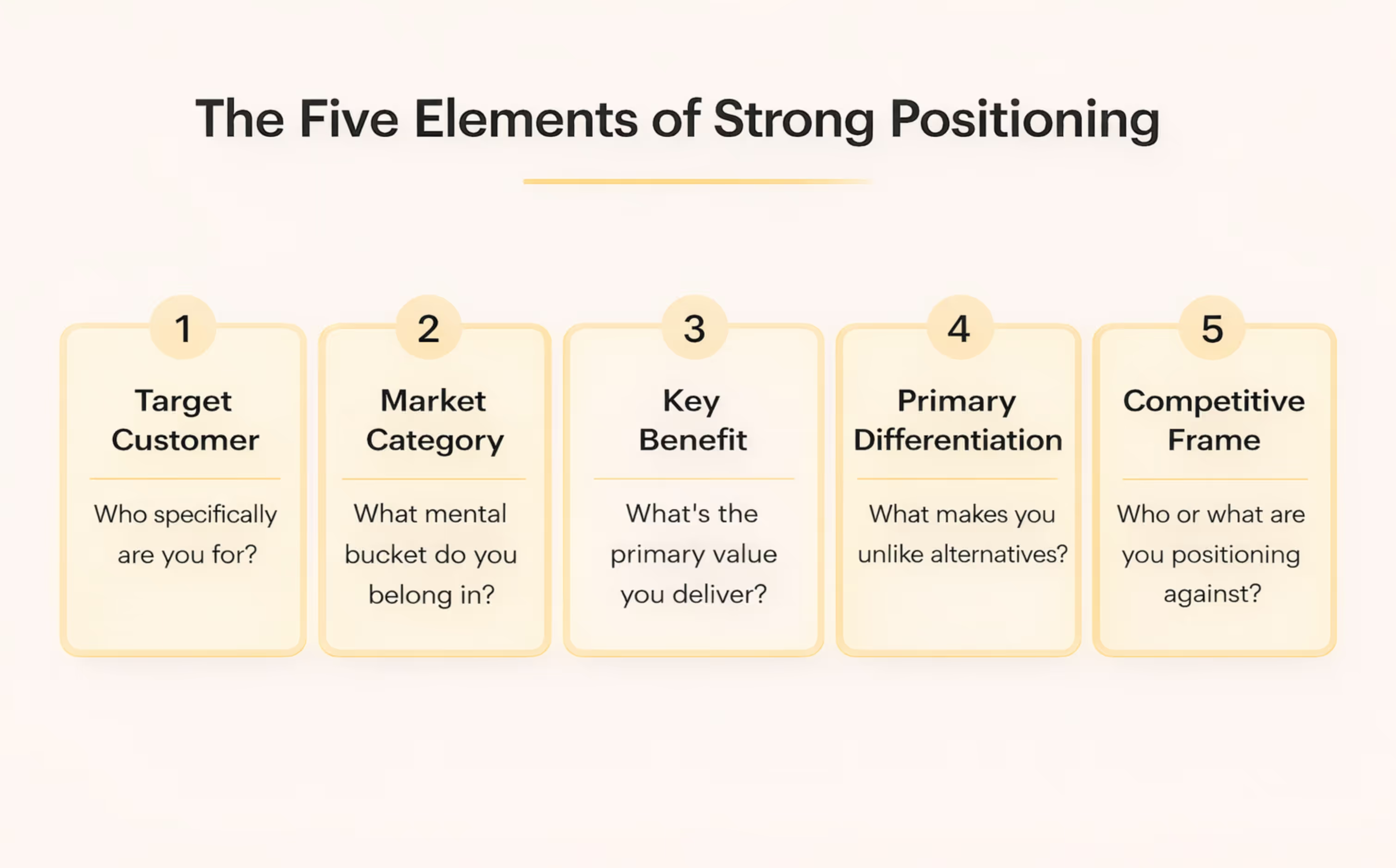
The Five Elements of Strong Positioning
The Five Elements of Strong Positioning by Metabrand
Regardless of which framework you use, strong positioning includes five elements.
1. Target Customer
Who specifically are you for?
The instinct is to say "everyone" or keep it broad to maximize market size. Resist this. Narrow targeting enables sharp positioning. You can expand later; you can't start unfocused and add focus.
Questions to answer:
What role or job title?
What company size or type?
What specific situation or need state?
What psychographic characteristics (values, attitudes, behaviors)?
Examples of sharp targeting:
Linear: "Engineering teams" (not all teams, not all project management users)
Notion: "Teams who want flexibility" (not teams who want rigid structure)
Mercury: "Startups" (not all businesses, not established enterprises)
The narrower your target, the more specific your positioning can be. Specific positioning creates stronger preference among the target segment, even if it means less appeal to everyone else.
Jackson explains:
"As a rule, it's always an advantage to be first in your market, because you're memorable. If you can be first and best that's great — but that's also really hard, and it's okay if you're not. Positioning statements help you create the right message for the right person at the right time."— Arielle Jackson
2. Market Category
What mental bucket do you belong in?
Category choice shapes how customers discover, evaluate, and compare you. Three strategies exist:
Enter an existing category. Easiest for customers to understand. You're a "CRM" or a "project management tool" or an "email client." The risk: you inherit category expectations and competition.
Create a new category. Hardest but potentially most valuable. Salesforce created "cloud CRM." HubSpot created "inbound marketing platform." Category creation requires educating the market — expensive and slow.
Subcategorize an existing category. Middle path. You're a "CRM for real estate" or a "project management tool for engineering teams" or an "email client for executives." You get category recognition with differentiated positioning.
For most startups, subcategorization is the right choice. You inherit category infrastructure (existing search demand, understood evaluation criteria) while claiming a differentiated space.
3. Key Benefit
What's the primary value you deliver?
Not a feature list — the outcome customers care about. Features enable benefits; benefits are what customers buy.
Feature vs. benefit:
Feature: "Real-time multiplayer editing"
Benefit: "Never deal with version conflicts again"
Feature: "AI-powered email triage"
Benefit: "Get through your inbox twice as fast"
Feature: "Native integrations with 200+ tools"
Benefit: "Your tools work together automatically"
The best benefits are specific and measurable when possible. "Save time" is weak. "Get through email twice as fast" is strong.
4. Primary Differentiation
What makes you unlike alternatives?
Differentiation must be three things:
True. You actually have this difference. Aspiration isn't positioning.
Relevant. The target customer cares about this difference. Unique features no one wants aren't differentiation.
Defensible. The difference isn't easily copied. If a competitor can match it next quarter, it's not sustainable differentiation.
Common differentiation types:
Features: Unique capabilities competitors lack
Approach: Different methodology or philosophy
Focus: Serving a segment competitors ignore
Experience: Superior usability, design, or service
Integration: Working better with specific ecosystems
Price: Significantly cheaper (or premium for significantly better)
The strongest positioning combines multiple differentiation types. Stripe differentiates on developer experience and API design and documentation quality and ecosystem integration. Each alone might be copyable; together, they're a moat.
5. Competitive Frame
Who or what are you positioning against?
You're always positioning against something — even if it's the status quo of doing nothing. Explicit competitive framing helps customers understand your place in the landscape.
Direct competitors: Other products in your category. "Unlike Asana, we focus exclusively on engineering workflows."
Indirect competitors: Alternative solutions to the same problem. "Unlike hiring an agency, we let you control everything in-house."
Status quo: The current way of doing things. "Unlike managing subscriptions with spreadsheets, we automate the entire process."
Previous generation: Older approaches in your category. "Unlike traditional banks, we're built entirely for the digital age."
Choose the competitive frame that makes your differentiation clearest. If you're entering an established category, frame against the leader. If you're creating a new category, frame against the status quo.
Step-by-Step: How to Develop Your Positioning
Positioning isn't a creative brainstorm. It's a strategic analysis. Here's the process.
Step 1: Gather Inputs
Before writing anything, collect data.
Customer interviews: Talk to your best customers. Ask:
Why did you choose us?
What alternatives did you consider?
What would you tell a friend about what we do?
What would happen if we didn't exist?
Lost deal analysis: Talk to prospects who didn't convert. Ask:
What did you choose instead?
What was the deciding factor?
How did you perceive us vs. the alternative?
Competitive analysis: Document how competitors position themselves.
What claims do they make?
What language do they use?
What segments do they target?
Internal alignment: Interview founders and leadership.
What's our vision for the company?
What do we believe that competitors don't?
What are we willing to not do?
This research takes 1-2 weeks. Don't skip it. Positioning built on assumptions fails.
Step 2: Identify Your Best Customers
Not all customers are equal. Find the pattern among your best ones.
Define "best":
Highest lifetime value
Fastest sales cycle
Strongest product fit
Most enthusiastic advocates
Find the pattern:
What do they have in common?
What need drove their purchase?
What made them choose you over alternatives?
This pattern reveals your ideal target customer. The positioning should resonate with these customers, not a theoretical broader market.
Step 3: Map the Competitive Landscape
List all alternatives to your product:
Direct competitors (same category)
Indirect competitors (different approach to same problem)
Status quo (doing nothing or manual workarounds)
For each alternative, document:
How they position themselves
What they emphasize
What they ignore or do poorly
Look for white space — positions that aren't claimed or are weakly held.
Step 4: Identify Your Differentiation
Based on customer research and competitive analysis:
What do customers consistently cite as reasons for choosing you?
This reveals your actual differentiation (not what you wish it was).
What do competitors not do or not do well?
This reveals opportunities for differentiation.
What can you do that competitors can't easily copy?
This reveals sustainable differentiation.
Prioritize differentiation that is true, relevant, and defensible. A list of 10 differentiators dilutes positioning. Find the 1-2 that matter most.
Step 5: Choose Your Category
Based on differentiation and competitive analysis:
Can you win in an existing category?
If your differentiation is strong enough to displace incumbents, enter the existing category.
Should you create a subcategory?
If you serve a specific segment better than generalists, subcategorize.
Should you create a new category?
Only if your approach is fundamentally different and you have resources to educate the market.
For most startups, subcategorization is right. "CRM for real estate" is easier to own than "CRM."
Step 6: Write the Positioning Statement
Using the First Round framework:
For [target customer]Who [need or opportunity],[Product] is a [category]That [key benefit].Unlike [competitive alternative],[Product] [primary differentiation].
Write multiple versions. Test each element:
Is target specific enough?
Is need real and urgent?
Is category clear?
Is benefit measurable?
Is differentiation true, relevant, defensible?
Step 7: Validate
Don't finalize positioning in a conference room. Test it.
With customers: Does this resonate? Does it match why you chose us?
With prospects: Does this clarify what we do? Does it make you more interested?
With team: Can everyone repeat this consistently? Does it guide decisions?
With competitors: Is this space unoccupied? Can we defend it?
Iterate based on feedback. Positioning isn't final until it's validated.
Positioning Examples: What Great Looks Like
Let's analyze positioning from companies that nailed it.
Stripe
Target: Developers building internet businesses
Category: Financial infrastructure platform
Key benefit: Focus on your product, not payments
Differentiation: Developer experience, API design, documentation quality
Positioning (implied):
For developers building internet businesses who need to accept payments, Stripe is financial infrastructure that lets them focus on product instead of payments. Unlike legacy payment processors that require complex integration, Stripe provides elegant APIs, comprehensive documentation, and handles all payment complexity behind the scenes.
Why it works:
Stripe chose to position for developers, not business decision-makers. This was counterintuitive — developers don't control payment processor budgets. But developers influence decisions, and no competitor owned the developer experience position. By being the "developer-first" payment platform, Stripe built preference that drove bottom-up adoption.
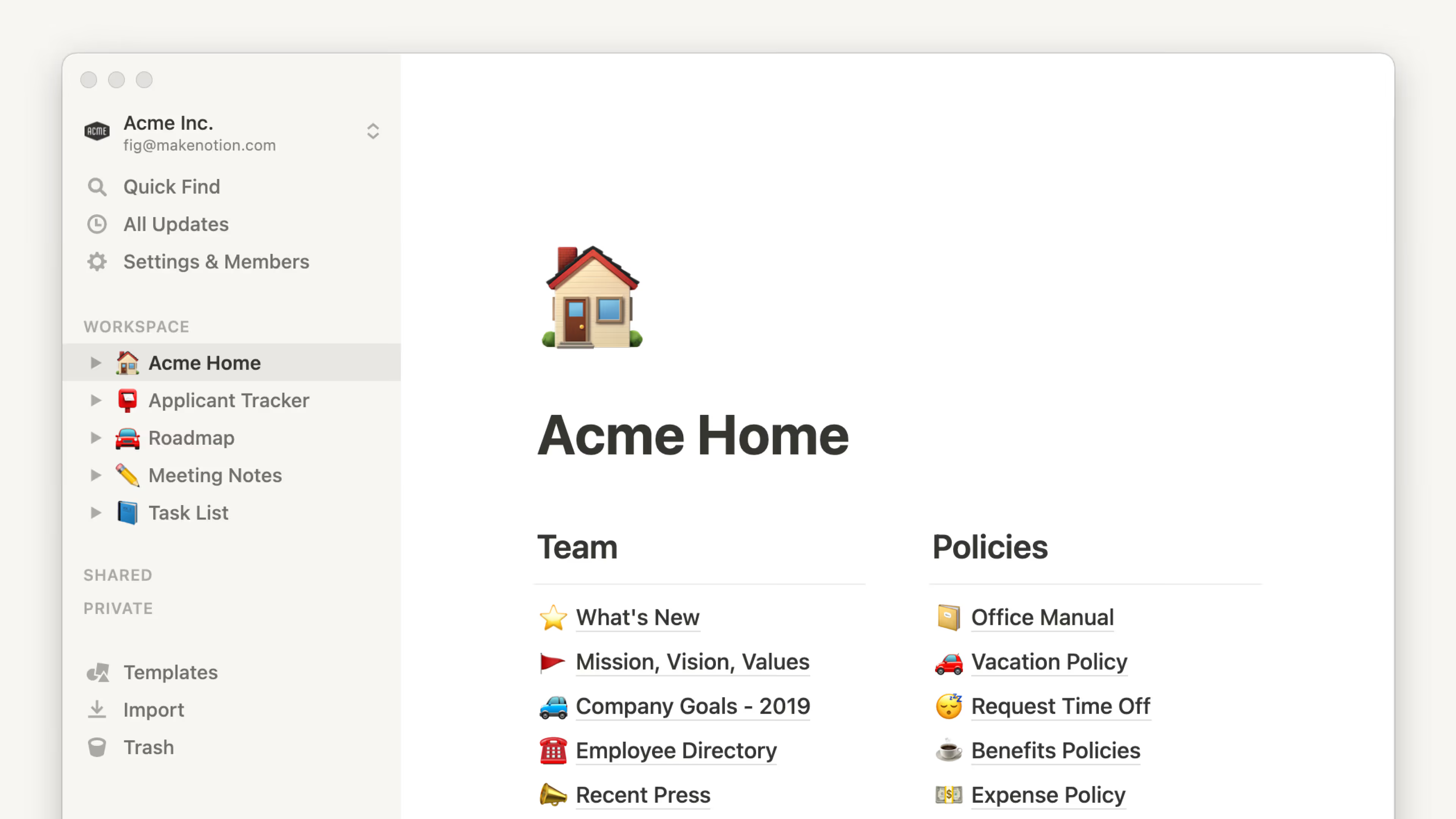
Notion: All-in-one tool that adapts to your workflow
Notion
Target: Teams who want flexibility in how they work
Category: Connected workspace
Key benefit: All-in-one tool that adapts to your workflow
For teams frustrated by rigid, single-purpose tools, Notion is a connected workspace that adapts to any workflow. Unlike specialized tools that force you to work their way, Notion's building blocks let you create exactly the system you need.
Why it works:
Notion positioned against the category of specialized tools — not a specific competitor. "Unlike specialized tools" creates a positioning that's defensible against any single competitor. The "flexibility" positioning attracts customers who've bounced between tools looking for the right fit.
Linear
Target: Engineering teams
Category: Issue tracking
Key benefit: Speed that matches how engineers work
For engineering teams frustrated by slow, bloated project management tools, Linear is issue tracking built for speed. Unlike legacy tools designed for general project management, Linear is optimized for software development workflows with keyboard-first design and instant performance.
Why it works:
Linear positioned against "legacy tools" and "general project management." By targeting specifically engineering teams and claiming speed, they created a position that Jira and Asana couldn't credibly own. Speed isn't just a feature — it's the organizing principle of their positioning.
Mercury
Target: Startups
Category: Banking
Key benefit: Banking designed for startups
Differentiation: Startup-specific features, modern UX, VC integration
Positioning (implied):
For startups who need banking that understands their business, Mercury is the banking platform built specifically for high-growth companies. Unlike traditional banks designed for established businesses, Mercury offers startup-specific features like VC integration, team cards, and instant account access.
Why it works:
Mercury positioned against traditional banks with a narrow focus on startups. This let them build features traditional banks would never prioritize and develop credibility within a specific community. The positioning gave them permission to ignore customers who aren't startups — and become indispensable to those who are.
Common Positioning Mistakes
Mistake 1: Positioning for Everyone
"We're for anyone who needs X."
This isn't positioning — it's abdication of strategy. If you're for everyone, you're optimized for no one. Narrow targeting feels risky but enables sharp differentiation.
Fix: Define your ideal customer specifically. Who are your best 10 customers? What do they have in common? Target that.
Mistake 2: Feature-First Positioning
"We have AI-powered analytics with real-time dashboards and 200+ integrations."
Features don't position. Benefits position. Customers buy outcomes, not capabilities.
Fix: For every feature, ask "so what?" until you reach a human outcome. AI-powered analytics → see problems faster → fix issues before customers notice → reduce churn.
Mistake 3: Aspirational Positioning
"We're the most innovative platform in the market."
If you have to say it, it's not positioning. Positioning must be demonstrably true today, not aspirationally true tomorrow.
Fix: Position on current strengths. Innovation is an outcome of consistent delivery, not a claim.
Mistake 4: Me-Too Positioning
"We're like [Leader] but better."
This cedes the positioning battle. You're accepting the leader's frame and competing on their terms.
Fix: Find a different dimension to compete on. If the leader owns "comprehensive," own "simple." If they own "enterprise," own "startup." Different, not better.
Mistake 5: Positioning by Committee
"Let's incorporate everyone's feedback."
Committee-driven positioning produces bland consensus that offends no one and inspires no one.
Fix: Small team makes the call. Gather input broadly, decide narrowly. Positioning requires courage to exclude.
Mistake 6: Changing Positioning Too Often
"We're pivoting our positioning based on last quarter's feedback."
Positioning takes time to land. Customers need repeated exposure to associate you with a position. Constant changes prevent any position from forming.
Fix: Commit to positioning for at least 12-18 months. Iterate on expression and execution, not the core position.
When to Revisit Positioning
Positioning isn't permanent. Revisit when:
Market has fundamentally shifted. New technology, new competitors, or new customer expectations invalidate your current position.
You've achieved the position. Success creates opportunity to expand. Once you own "issue tracking for engineers," you can expand to adjacent segments.
The position isn't working. If messaging derived from positioning consistently fails to resonate, the positioning itself may be wrong.
The company has pivoted. New product direction or business model requires new positioning.
You've outgrown the position. "Banking for startups" may be too narrow when you have 10,000 startup customers and want enterprises.
But don't revisit because you're bored or competitors are doing something different. Positioning requires patience to take hold.
Positioning Templates and Resources
Template: First Round Positioning Statement
For [target customer]
Who [statement of need or opportunity],
[Product name] is a [product category]
That [statement of key benefit].
Unlike [competing alternative],
[Product name] [statement of primary differentiation].
Template: Positioning Brief
Target Customer
Role/title:
Company type:
Situation/need state:
Psychographics:
Market Category
Existing category:
Subcategory (if applicable):
Adjacent categories:
Competitive Landscape
Direct competitors:
Indirect competitors:
Status quo alternative:
Differentiation
Unique attributes:
Proof points:
Defensibility:
Key Benefit
Primary outcome:
Supporting outcomes:
Proof/evidence:
Positioning Statement[Write using First Round template]
☐ Target is specific. You can describe your ideal customer precisely, not broadly.
☐ Need is real. Customers confirm this problem exists and matters.
☐ Category is clear. Customers understand what bucket you belong in.
☐ Benefit is measurable. You can point to specific outcomes, not vague improvements.
☐ Differentiation is true. You actually have this difference today.
☐ Differentiation is relevant. Customers care about this difference.
☐ Differentiation is defensible. Competitors can't easily copy it.
☐ Competitive frame is explicit. You know what you're positioning against.
☐ Team can repeat it. Everyone articulates position consistently.
☐ Customers validate it. The positioning resonates in actual conversations.
Positioning is the foundation. Get it right, and everything else becomes clearer — messaging, identity, campaigns, product decisions. Get it wrong, and you'll fight unclear strategy at every turn.
Frequently Asked Questions
What is brand positioning for startups?
Brand positioning is the strategic process of defining how your startup occupies a distinct place in customers' minds relative to competitors. It answers three questions: who you're for, what problem you solve, and why you're the best choice. Effective positioning isn't about being everything to everyone — it's about being the obvious choice for a specific audience with a specific need. For startups, clear positioning guides every decision from messaging to product roadmap.
How do I know if my startup's positioning is working?
Strong positioning shows up in measurable ways: customers can accurately describe what you do without prompting, sales cycles shorten because prospects self-qualify, you win competitive deals on value rather than price, and your marketing resonates immediately. If prospects constantly ask "so what exactly do you do?" or compare you unfavorably to larger competitors, your positioning likely needs work. Test by asking recent customers why they chose you — their language reveals your actual position.
When should a startup revisit its positioning?
Revisit positioning when you've found product-market fit and your initial assumptions have been validated or invalidated, when you're expanding to new customer segments or markets, when competitors have repositioned and your differentiation has eroded, or after significant product changes that alter your value proposition. Most startups should expect to refine positioning 2-3 times in their first five years as they learn more about their customers and market.
Ready to Define Your Positioning?
If you're a founder working through positioning decisions — or wondering if your current positioning is holding you back — we can help.
Metabrand works with tech startups from seed through Series C to develop positioning that creates competitive advantage. Our process combines strategic frameworks with real customer research to find positions that are true, differentiated, and ownable.