By clicking "Accept all cookies", you agree to storing cookies on your device to enhance site navigation, analyze site usage and assist in our marketing efforts as outlined in our privacy policy.
By clicking 'Accept all cookies', you agree to storing cookies on your device to enhance site navigation, analyze site usage and assist in our marketing efforts as outlined in our privacy policy.
A brand refresh and a rebrand are not the same thing, and choosing the wrong one costs time, money, and brand equity. The confusion is understandable — both involve changing how your company looks and sounds, and agencies don't always draw a clear line between them. This guide does. By the end, you'll know exactly what a brand refresh includes, how it differs from a full rebrand across every dimension that matters, and which signals point toward one versus the other for your business.
What Is a Brand Refresh?
A brand refresh is a focused update to an existing brand's visual and verbal presentation, designed to modernize and sharpen the identity without changing the underlying strategy, positioning, or brand name.
The operative phrase is "without changing the underlying strategy." That's what separates a brand refresh from what a rebrand actually means at a strategic level.
In practice, a brand refresh typically includes some or all of the following:
Updated logo. Not a replacement — an evolution. Cleaner lines, refined proportions, better performance across digital contexts. The logo should remain recognizable to existing customers.
Refined color palette. Modernized tones, better contrast ratios, expanded secondary palette for digital flexibility — while the core brand colors stay anchored.
Modernized typography. Replacing dated typefaces with contemporary alternatives that carry similar character, or tightening an inconsistent typographic system into a coherent one.
Tightened messaging. Sharpening the tagline, refreshing the brand voice guidelines, cleaning up the boilerplate — without repositioning who the brand is for.
Updated brand guidelines. Documenting the refreshed system so the team can apply it consistently.
What a brand refresh does not include: a new company name, a new positioning strategy, a new target audience, or a restructuring of the brand's competitive story. If any of those are on the table, you're looking at a rebrand, not a refresh. Understanding visual identity vs brand identity is useful here — a refresh operates primarily at the visual identity layer, while a rebrand typically touches brand identity at a deeper level.
Brand Refresh vs Rebrand: The Key Differences
The brand refresh vs rebrand question comes up in almost every initial client conversation. Here's how the two compare across the dimensions that actually affect the decision.
Scope
A brand refresh is contained: visual identity, verbal identity, possibly the messaging framework. The strategy underneath stays the same. A rebrand touches everything — name, positioning, visual system, messaging, and sometimes the product or service framing. The scope difference is significant because it drives every other variable: time, cost, risk, and the level of internal disruption involved.
Business rationale
A brand refresh makes sense when the brand's strategy is sound but the execution has aged. The company knows who it is and who it's for — it just doesn't look or sound like it should anymore. A rebrand is the right call when the strategy has changed: new audience, new category, post-acquisition realignment, or a brand that actively creates friction with the company's goals.
Timeline
A brand refresh runs 6 to 12 weeks for most businesses, assuming the scope is well-defined going in. A full rebrand typically takes 4 to 6 months at minimum — and for larger organizations with multiple product lines, international markets, or significant internal stakeholder management requirements, substantially longer.
Budget
A brand refresh for a startup or SME typically falls in the $15,000 to $60,000 range. A full rebrand starts higher and scales with scope. The cost difference isn't arbitrary — a rebrand involves more strategic work, more rounds of exploration, more stakeholder alignment, and a much larger rollout. For a detailed branding cost breakdown across both scenarios, see the full pricing guide.
Risk
Brand refreshes carry low risk when executed well. You're improving something that's already working, not replacing it. Customer recognition stays intact. The main risk is scope creep — starting as a refresh and gradually becoming a rebrand without the strategic foundation to support it. Rebrands carry higher risk because they ask customers, employees, and the market to update associations they've built over time. That's manageable, but it requires a clear rationale and disciplined execution.
Customer impact
After a brand refresh, existing customers should notice an improvement — cleaner, more polished, more professional — but they shouldn't be confused. After a rebrand, customers need to be told what's changed and why. The communication work around a rebrand is substantial; for a refresh, it's minimal. For recent rebrands worth studying to understand how companies manage that transition, those cases illustrate the customer communication challenge well.
When a Brand Refresh Is Enough
Most of the time, a brand refresh solves the problem. Here's when it's the right scope.
The identity has aged but the strategy hasn't. The company knows what it does and who it's for. The logo was built in a different era of design, the typography looks dated on a Retina display, the color palette doesn't translate to digital — but the positioning is solid. A refresh modernizes without disrupting.
The brand is consistent but uninspiring. Everything is applied correctly, the guidelines are followed, but nothing feels distinctive. A brand refresh can sharpen what's there and introduce more character, without throwing away the recognition you've built.
You're entering a new market or growth phase, but the core positioning holds. A Series B raise, a new sales channel, or a geographic expansion often surfaces the need for a more polished, professional identity. The brand strategy doesn't need to change — it just needs to be executed at a higher level.
Your visual identity creates friction in specific contexts. The logo doesn't work in monochrome. The primary color fails accessibility contrast standards. The typeface isn't available in the weights you need for digital use. These are fixable problems that don't require a full rebrand.
Competitor pressure has made you look generic. If you and three competitors have ended up with nearly identical identities through convergent design trends, a brand refresh can differentiate without requiring a full strategic rethink. The positioning is fine — the visual expression just needs to stand apart.
When You Actually Need a Rebrand Instead
A brand refresh is iterative. Some problems are too structural for iteration to fix.
The brand represents a company you no longer are. The original identity was built around a product you've discontinued, an audience you've moved on from, or a positioning that no longer reflects the business. Refreshing those assets doesn't close the gap — it just polishes the wrong picture.
The name is limiting growth. The company has pivoted, expanded scope, or moved into a new category — and the name anchors it in the wrong place. A refresh can't fix a name. This is a rebrand trigger, full stop.
The brand carries associations you can't evolve past. A significant reputational event, a product failure, or a public misstep can attach associations to a brand that incremental improvement won't shake. Sometimes the only credible signal of genuine change is a genuine brand change.
A merger or acquisition has created two brands that need resolution. You can't refresh your way out of a structural identity conflict. Post-M&A brand architecture requires a rebrand, whether that means one brand absorbing the other or both giving way to something new.
The positioning has fundamentally changed. You've moved upmarket, into a new category, or toward a completely different buyer profile. The brand refresh vs rebrand question resolves clearly here: if the strategy has changed, the brand needs to change with it. To understand what that process involves and when to work with a rebranding agency, the full guide covers both the decision criteria and the engagement models.
What a Brand Refresh Costs and How Long It Takes
Most brand refreshes fall in the $15,000 to $60,000 range, with timeline running 6 to 12 weeks. Those are wide ranges because scope varies significantly. Here's what drives the variation.
Number of touchpoints. A startup with a website, a pitch deck, and a LinkedIn profile has a manageable rollout. A company with a product UI, a physical location, a sales team, packaging, and multiple marketing channels has a much larger asset inventory to update. The cost of the refresh work itself may be similar; the implementation cost scales with touchpoints.
Guidelines documentation. If the company has existing brand guidelines that need to be updated, that's contained work. If there are no guidelines and the refresh needs to build a complete system from scratch — typography scale, color system, icon library, usage rules — that adds scope.
Whether messaging is included. A visual-only refresh is narrower and faster. If the refresh also includes a messaging framework, brand voice guidelines, or tagline development, that adds strategic work and additional rounds of input.
Agency overhead and market. A boutique agency working with a startup runs differently than a large brand consultancy working with an enterprise. Both can produce excellent work; the cost structure differs.
As a rough calibration: a focused brand refresh for a Series A startup (new logo system, updated color palette, revised typography, basic guidelines) runs 6 to 8 weeks and $20,000 to $35,000 with the right agency. Add messaging work, a larger asset set, or a more complex stakeholder environment and you move toward the upper end of the range.
1. Brand audit. Before changing anything, you need an honest assessment of what exists. What's working? What's dated? What's inconsistent? The audit looks at the current visual identity, how it's being applied across touchpoints, any existing guidelines, and competitive context. It takes one to two weeks and prevents the team from solving the wrong problem.
2. Strategic direction. Even a brand refresh needs a clear brief: what is the refresh trying to achieve, what should stay, and what needs to change? This is shorter than the full strategy phase of a rebrand, but skipping it is how refreshes end up incoherent. This is also where the decision gets confirmed: is this genuinely a refresh scope, or has the conversation revealed something more significant?
3. Concept development and refinement. The agency presents visual and verbal directions based on the brief. The client reviews, responds, and the chosen direction gets refined into a full system. Two to three rounds of feedback is typical for a refresh.
4. System development. The refined direction gets built out into a complete identity system: all logo variants, full color system, typography scale, usage guidelines. This is the deliverable that makes the refresh sustainable — it's what lets the team apply the new identity consistently.
5. Rollout. The new identity rolls out across touchpoints in a coordinated sequence, starting with the highest-visibility assets (website, social profiles, email signatures) and working through the full asset inventory. Internal communication happens before external launch.
Examples of Successful Brand Refreshes
Google's rebranding from its serif wordmark to a custom sans-serif logotype
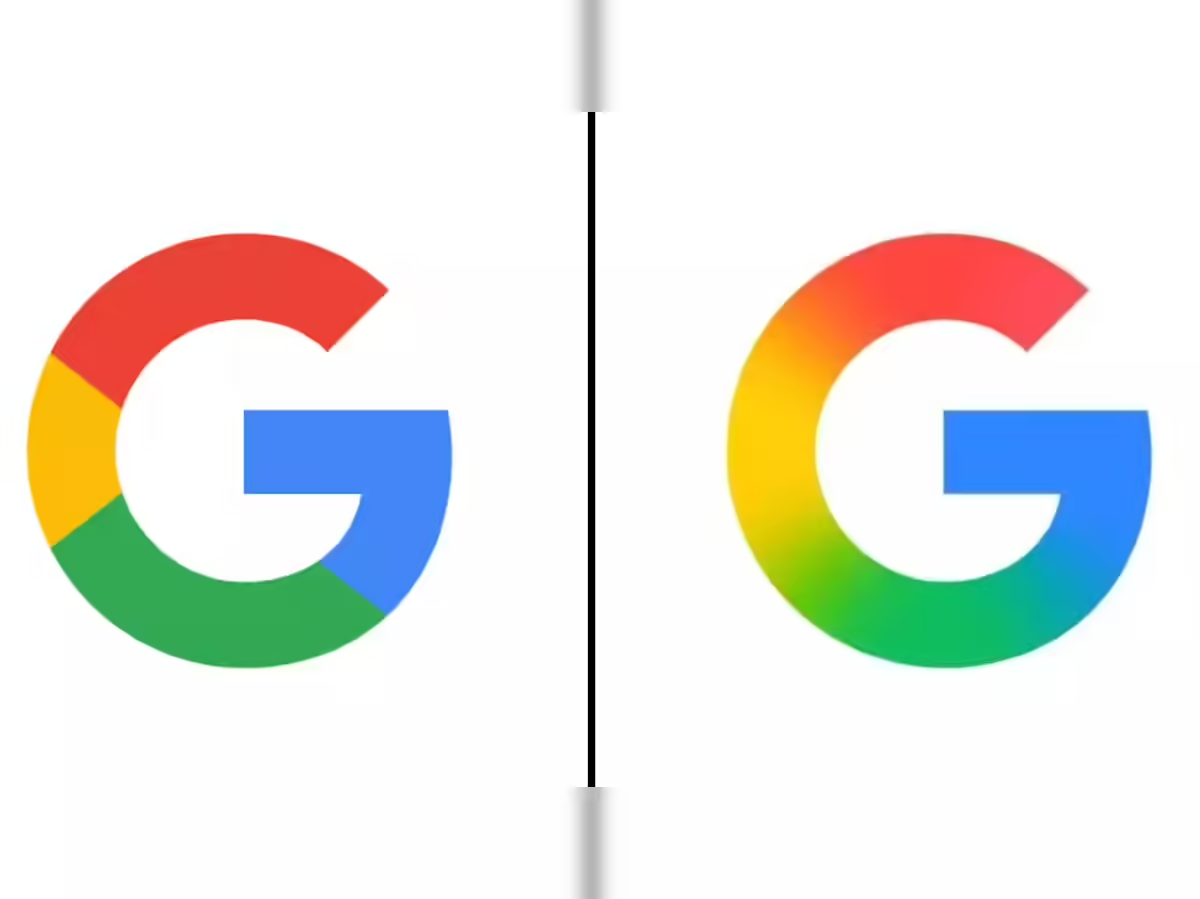
Google (2015). Google's transition from its serif wordmark to a custom sans-serif logotype is one of the most studied brand refreshes in recent history. The core identity — the four-color sequence, the name, the brand personality — stayed entirely intact. What changed was the typographic expression, optimized for the digital contexts where Google now primarily lived. Revenue, recognition, and market position were never in question. The refresh modernized execution without touching strategy.
Mastercard (2016). Mastercard refined its logo by simplifying the geometry, removing the wordmark from the mark itself, and optimizing for the environments where the brand actually appears: digital wallets, tiny app icons, physical card designs. The interlocking circles stayed. The color relationship stayed. The brand meaning stayed. This is brand refresh at its most precise — removing friction between the identity and its contexts without changing what the identity communicates.
Burger King (2021). Burger King's refresh is notable because it moved backward in time rather than forward, returning to a nostalgic visual language rooted in the 1970s and 1980s. The result was a distinctive departure from the overly literal, 3D-rendered fast food aesthetic that had converged across the category. New typeface, revised color palette, updated illustration style — but the same name, the same positioning, the same brand personality. It's a useful counterexample to the assumption that a brand refresh always means modernizing; sometimes the right move is deliberately retro.
Common Brand Refresh Mistakes
Scope creep into a full rebrand. This is the most common failure mode. A refresh starts with a logo update, then the positioning needs work, then the name starts to feel limiting, and six months later the company is deep into a full rebrand without the strategic foundation or budget to support it. Define the scope before the project starts and hold it.
Inconsistent rollout. A new logo on the website with the old logo still on LinkedIn, the pitch deck, and the email footer is worse than no refresh at all. It signals disorganization. Rollout needs a coordinated plan and someone accountable for executing it across every touchpoint.
No updated guidelines. A brand refresh that doesn't produce updated, documented guidelines will degrade within six months. Without documentation, the refreshed identity gets applied inconsistently, and the work loses its value. Guidelines are not optional deliverables.
Ignoring what's actually working. Some companies treat a refresh as permission to change everything. The equity in your existing brand — recognition, associations, emotional resonance — is real and often underestimated. Audit before you discard. Keeping what works is part of the brief.
Forgetting internal alignment. The team needs to know what changed, why, and how to apply it. A brand refresh that the internal team doesn't understand or believe in produces external materials that look new but feel hollow. Internal launch matters as much as external launch.
Frequently Asked Questions
What is a brand refresh?A brand refresh is a focused update to a company's visual and verbal identity — logo, typography, color palette, messaging — designed to modernize and sharpen the brand without changing its name, strategy, or market positioning.
How is a brand refresh different from a rebrand?A brand refresh evolves an existing identity within the same strategic framework. A rebrand changes the strategic foundation: the positioning, the target audience, sometimes the name. The test is whether the underlying strategy has changed. If it has, it's a rebrand. If the strategy is sound and the execution needs updating, it's a refresh.
How much does a brand refresh cost?For most startups and SMEs, a brand refresh runs between $15,000 and $60,000. The range is driven by scope: how many touchpoints need updating, whether messaging work is included, and whether new guidelines need to be built from scratch rather than updated.
How long does a brand refresh take?Most brand refreshes take 6 to 12 weeks from kick-off to final delivery. Factors that extend the timeline include a large asset inventory, multiple stakeholder approvers, and a combined visual and messaging scope.
Can a brand refresh include a logo change?Yes. A brand refresh commonly includes an updated logo — refined, modernized, or optimized for new contexts. What distinguishes it from a rebrand is that the new logo is an evolution of the existing mark, not a replacement. Existing customers should recognize the updated version immediately.
When should a company choose a refresh over a rebrand?Choose a refresh when the brand's strategy is correct but the execution has aged. If the company knows who it is, who it serves, and what differentiates it — but the visual and verbal identity doesn't reflect that at the right level — a refresh closes the gap. If the strategy itself has changed, a refresh won't be enough.
The rebrands that hold up share a pattern
Strategy before creative. Equity preserved where possible. Rollout coordinated across every touchpoint. These aren't luxuries — they're the difference between a rebrand that moves the business and one that just looks new.
Metabrand is a startup branding agency working closely with founders and technology teams to bring ambitious ideas to life and give them the clarity, character, and presence they deserve.
Thank you! Your submission has been received!
Oops! Something went wrong while submitting the form.
Learn More
Next Reads for Visionary Founders. Still Curious? Dive Deeper.