By clicking "Accept all cookies", you agree to storing cookies on your device to enhance site navigation, analyze site usage and assist in our marketing efforts as outlined in our privacy policy.
By clicking 'Accept all cookies', you agree to storing cookies on your device to enhance site navigation, analyze site usage and assist in our marketing efforts as outlined in our privacy policy.
Tech branding is one of those categories where almost every creative agency claims a specialty. In practice, the agencies that actually understand technology companies — how they sell, how they scale, what makes a brand hold up through product pivots and funding rounds — are a much shorter list. This guide breaks down what separates genuine tech branding expertise from surface-level capability, and names eight agencies whose work consistently holds up in demanding technology markets.
Last updated: October 2026. Disclosure: Metabrand wrote this guide and is one of the agencies listed. Each profile notes when the agency is not the right fit, ours included.
Whether you're a seed-stage startup figuring out your first serious identity, a Series B company that's outgrown its founding brand, or an enterprise technology company navigating a repositioning, the criteria for choosing a branding partner are different in tech. Here's what to look for and who's doing it well.
What Tech Branding Actually Is (And Isn't)
Tech branding is not a modern-looking logo and a dark-mode color palette. That's a visual style, and it describes half the portfolios in the industry. Tech company branding is a specific practice with distinct challenges that don't exist in the same form for consumer goods, hospitality, or professional services.
The actual problems technology branding needs to solve:
Explaining products people can't see. Software, platforms, and infrastructure products are intangible. The brand has to carry a significant portion of the persuasion work, translating what a product does and why it matters into something a buyer can grasp in the first few seconds of an interaction. Generic branding agencies rarely have the practice to do this reliably.
Building trust for high-stakes decisions. Enterprise software procurement is a high-stakes, long-cycle process. The brand communicates stability, credibility, and category authority before a single sales conversation happens. Technology branding that looks good but reads as immature creates friction at exactly the point where friction is most expensive.
Differentiating in converged categories. SaaS, fintech, cybersecurity, and developer tooling have all converged visually over the past decade. Geometric sans-serif typefaces, blue-and-white palettes, abstract mark logos — the category cues have become the default, which means they've stopped functioning as differentiation. Technology branding done well identifies where a company can credibly stand apart from the visual and verbal patterns of its category.
Serving technical and business audiences simultaneously. Most technology companies sell to both technical decision-makers and business buyers. A brand that resonates with one and alienates the other creates structural problems for growth.
Companies typically turn to a specialized tech branding agency when the existing identity is creating measurable friction: wrong-fit inbound, credibility gaps in enterprise sales, brand assets that don't scale across product lines, or a founding identity that no longer represents the stage the company has reached.
Why Tech Companies Need Specialized Branding
The case for branding for tech companies isn't that generalist agencies produce bad work — it's that the problems tech companies face require a specific kind of expertise that most generalist agencies haven't built.
A generalist agency that's mostly done retail, hospitality, or CPG work will approach a B2B SaaS brand as a visual identity problem. The output will be polished and well-crafted. It will probably fail to solve the actual problem.
Here's why. Technology branding requires understanding how the brand integrates with product marketing. The language the brand uses, the positioning it establishes, and the visual system it creates all have to work in product UI, in documentation, in sales enablement materials, in developer-facing contexts, and in enterprise procurement environments. These are different registers with different requirements, and managing the brand coherently across all of them is a skill that comes from having done it before, in technology companies specifically.
It also requires understanding the pace of tech markets. A brand built for a company's current product needs enough flexibility to accommodate the product roadmap. Brand systems that can't evolve without requiring a full rebuild become technical debt. Agencies without tech sector experience tend to build more rigid systems.
Finally, branding for tech companies often involves a degree of category and positioning work that generalist agencies aren't structured to deliver. The brand isn't just a visual expression of what the company is — it's an argument for why the company belongs in a specific market position. That strategic dimension requires familiarity with how technology markets are structured, how buyers evaluate category participants, and what signals separate category leaders from everyone else.
For a comprehensive branding cost breakdown across different technology company stages and project types, the full guide covers what these engagements typically include and where the investment goes.
How We Selected These Agencies
The agencies on this list were evaluated against a specific set of criteria, not a popularity ranking or a client count.
Track record with technology clients specifically. Not "we've worked with technology-adjacent clients" — a portfolio that includes SaaS companies, infrastructure businesses, developer tools, fintech, or similar categories where the branding challenges are genuinely technical.
Evidence of strategic capability. Case studies that explain the problem the brand was solving, not just the aesthetic direction taken. Agencies that can only show outcomes — beautiful logos without context — are presenting a portfolio, not evidence of problem-solving.
Implementation capability. Technology branding requires deliverables that translate into actual product and marketing environments. The ability to produce design systems, component libraries, and web-ready assets is a practical requirement.
Size and stage fit. Some agencies are built for Series A startups; others are structured for enterprise. Matching the agency to the company's stage matters more in tech than in most other sectors, because the pace and scope of work differ significantly.
Knowing how to choose the right branding agency before starting a search prevents the most common mistakes — evaluating on aesthetics alone, or choosing an agency whose client base doesn't resemble your company.
The 8 Best Tech Branding Agencies in 2026
Metabrand
1. Metabrand
Specialization: Positioning, identity, website and sales materials for seed to Series A tech startups Locations: New York, Berlin, Limassol (production)
Built only for tech startups from seed to Series A in SaaS, AI, fintech and B2B. Strategists with Landor and BBDO backgrounds lead every project, the plan runs backwards from a raise or launch date, and brand, website and sales materials ship together, from 3–4 weeks. Known for telling clients when a full rebrand isn't what they actually need. Also runs dedicated practices as a SaaS branding agency and fintech branding agency. Less suited to enterprise rollouts across many markets.
Pentagram
2. Pentagram
Specialization:Brand strategy and identity for technology companies Locations: London, New York, Berlin, Austin
Notable clients: Slack, Mastercard, Windows
Pentagram is a collective of independent partners, several of whom lead work for technology companies. The quality ceiling is high; so is the investment. Their work on Slack's identity system is a reference case for how enterprise technology brands can maintain warmth and accessibility without sacrificing credibility. The right fit for companies at growth or scale stages that need brand work to function at an international level. Not the right fit for early-stage startups on constrained budgets, where the engagement model and overhead don't match the project scope.
3. Clay
Specialization: Branding, UX and websites for technology companies Locations: San Francisco (headquarters), New York, Austin, Denver, Lisbon, Belgrade
Clay designs brands, digital products and websites under one roof, which suits product-led companies where the interface and the identity have to work as one system. Its client list runs from fintech to consumer platforms. Better fit from Series A onward; teams that mainly need positioning before design will be better served by a strategy-first agency.
koto.studio
4. Koto
Specialization: Brand identity for technology platforms and digital brands Locations: London, Berlin, New York, Los Angeles, Sydney
Notable clients: Google, Netflix, Tripadvisor, WhatsApp, JP Morgan
Koto is known for vivid, confident identities that feel current without chasing trends, and works for both global tech companies and funded startups. A strong option for consumer-facing technology that needs to stand out. Budgets typically start around $60,000, which puts it out of reach for many seed-stage teams.
5. Collins
Specialization: Brand strategy and identity for growth-stage and public technology companies Locations: New York, San Francisco
Notable clients: Mailchimp, Dropbox, Spotify
Collins led the Dropbox and Mailchimp rebrands, two reference cases for how a software company can feel human without losing credibility. The right partner for Series B and later companies ready to redefine their category; the investment level doesn't fit early-stage budgets.
Bolder
6. Bolder
Specialization: Brand strategy, visual identity, and websites for AI, robotics, deep tech, energy, and biotech startups Location: London, Berlin, New York, San Francisco
Notable clients: Science and engineering-driven startups and scaleups
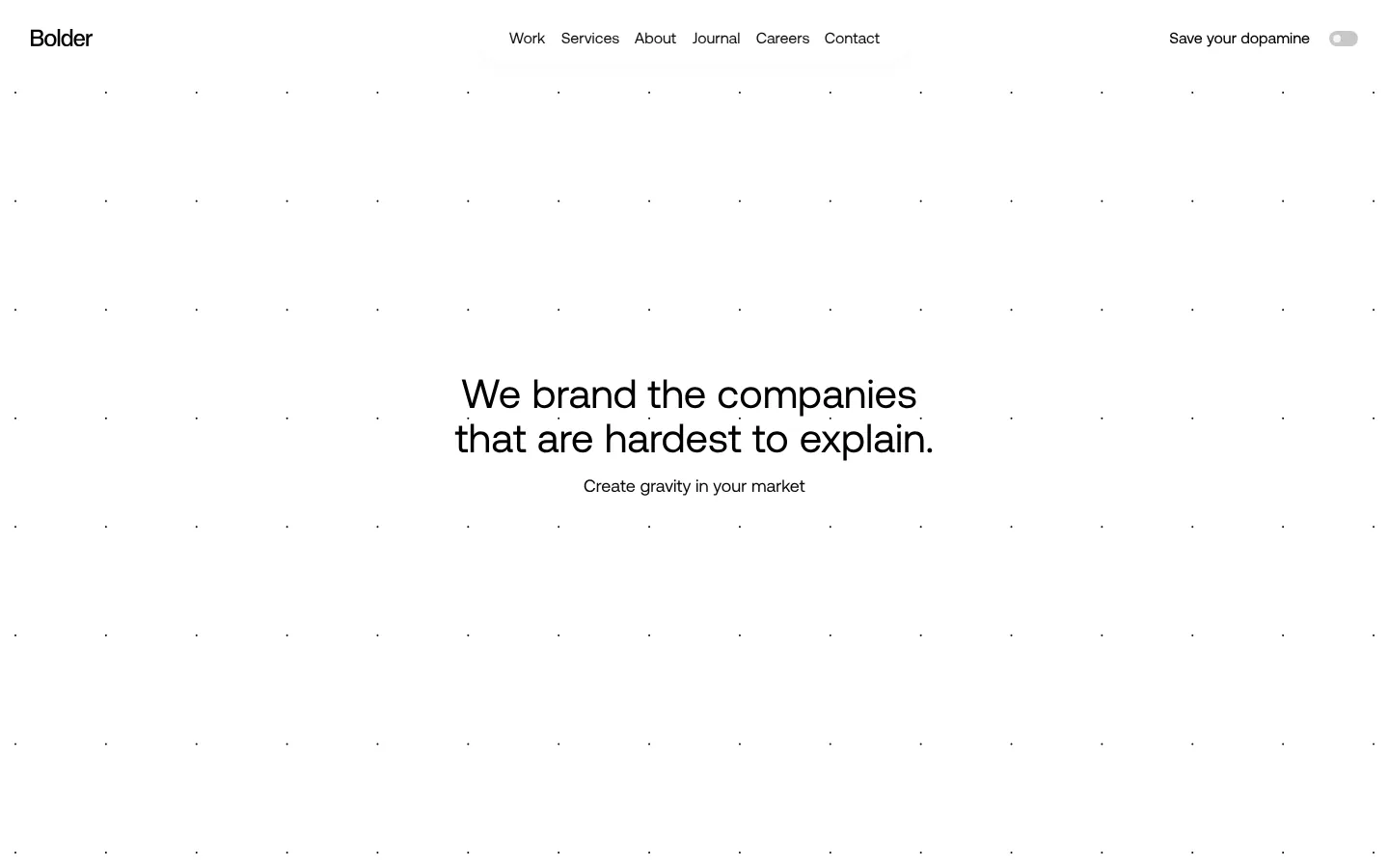
Bolder is a branding and communications agency for technology companies that are hardest to explain. Bolder works with science and engineering-driven startups and scaleups across AI, robotics, biotech, energy, and deep tech, where the gap between what the company does and how it’s understood is often the biggest barrier to growth. The work starts with clarity. The team helps founders get sharp on what they’re building and why it matters, then shapes the narrative, positioning, messaging, visual identity design, and website into a brand system that creates gravity in the market.
Superside
7. Superside
Specialization: Ongoing brand design and creative operations for scaling technology companies Location: Distributed globally
Superside operates on a subscription model rather than a project basis, which makes them a different kind of branding partner: less suited for foundational brand strategy work, well-suited for companies that need sustained, high-volume brand execution across many channels and touchpoints. For technology companies that have a brand system in place and need consistent, scalable implementation, Superside's model is efficient. For companies still establishing their brand foundation, the model doesn't match the work required.
Manypixels
8. Manypixels
Specialization: Unlimited design on a subscription model, with technology company focus Location: Singapore / Distributed
Notable clients: Technology and software startups across Southeast Asia and Europe
Similar subscription model to Superside but positioned for earlier-stage companies with leaner budgets. The trade-off is depth of strategic capability for breadth of execution output. For a technology startup that has done its positioning and messaging work independently and needs reliable ongoing brand execution — social assets, pitch decks, web graphics — Manypixels is cost-effective. For companies that need strategic brand work from the ground up, the model isn't the right fit.
Tech Branding by Subvertical
Tech company branding is not a uniform discipline. The requirements shift considerably depending on which technology category a company operates in.
SaaS and B2B software. The central challenge is differentiation in visually and verbally converged markets. Most SaaS companies look and sound similar because they've all drawn from the same pool of references. Good SaaS branding identifies where a company's actual positioning diverges from the category default and makes that visible.
Fintech. Technology branding in financial services has to balance two competing requirements: the trust and stability signals that financial services demand, and the modernity and clarity that technology products require. Most fintech brands land too far in one direction. The best fintech branding holds both simultaneously.
Biotech branding. Biotech presents distinct credibility requirements: the audiences are highly technical, the stakes are high, and premature or overstated claims have serious consequences. Biotech branding has to communicate scientific seriousness without becoming inaccessible to the non-scientist decision-makers who influence procurement and investment.
Health tech branding. Health tech branding operates at the intersection of clinical credibility and consumer accessibility. Brands that read as clinical alienate consumer audiences; brands that read as consumer products create skepticism in clinical environments. The balance point is company-specific and requires genuine category experience to find.
Deep tech and AI. Artificial intelligence and robotics companies face the challenge of communicating capability without overclaiming. In a market where AI is used as a generic descriptor for anything algorithmic, meaningful differentiation requires specificity and restraint. The branding that holds up is the kind that can explain what the technology actually does.
Developer tools and infrastructure. Developer-facing brands have to earn credibility with a technically literate audience that is deeply skeptical of marketing language. Authenticity, clarity, and functional demonstration matter more than visual polish in these markets.
Cybersecurity. Cybersecurity branding tends toward dark palettes, shield iconography, and defensive language — all of which have become category clichés that no longer differentiate. The companies building distinctive cybersecurity brands are the ones willing to move away from the category defaults.
How Much Does Tech Branding Cost?
Technology branding costs scale with company stage, project scope, and the strategic depth involved.
For a seed-stage startup, a focused branding engagement — positioning work, identity system, basic messaging framework — typically runs $15,000 to $40,000. This covers the foundations without the overhead of a large agency engagement or the scope of a full brand architecture project.
For a Series A or Series B company needing comprehensive brand work — full strategy, identity system, messaging platform, guidelines, and implementation support — the range moves to $40,000 to $120,000. The higher end of this range usually involves more stakeholder complexity, a larger asset delivery, or a combined positioning and identity scope.
For an enterprise technology company undertaking a full rebrand — multiple product lines, international markets, enterprise sales environment, UI/UX integration — the investment runs $150,000 to $400,000 and higher. The cost is driven by scope: how much strategic work is required, how many touchpoints need updating, how much implementation support is needed post-delivery.
The factors that move any project toward the higher end of its range: integration with product design, positioning work that requires market research, a large existing asset inventory that needs updating, and stakeholder environments that require extensive alignment work.
Red Flags When Choosing a Tech Branding Agency
A portfolio of beautiful logos without strategic context. If an agency can show you work that looks good but can't explain the problem it was solving, the category it was differentiating within, or the outcome it produced — that's a design studio, not a branding agency. The work might be excellent. It's not evidence of strategic capability.
They can't explain their own process. An agency that delivers good work has a process that accounts for it. If the answer to "how do you approach a new tech branding engagement?" is vague, general, or primarily focused on deliverables rather than methodology, treat that as a signal.
The case studies are all from one industry they'll call "similar enough." An agency that has done strong work in retail or hospitality isn't necessarily equipped for technology branding. "We've worked with fast-moving companies" is not the same as understanding enterprise software sales, developer audiences, or the specific credibility requirements of fintech.
No implementation capability beyond creative. Technology companies need brand systems that work in real digital environments — web, product UI, documentation, developer portals. An agency that delivers static design files without the capability to support implementation is leaving a significant gap.
Promises that feel too fast. Meaningful brand strategy and identity work for a technology company takes time. An agency promising a complete brand in a few days is either selling a template or making a promise it can't keep. A senior team can deliver a focused identity in three to four weeks, but only with a clear scope and fast decisions. Both outcomes are expensive.
Frequently Asked Questions
What is a tech branding agency?A tech branding agency is a branding firm that specializes in technology companies — SaaS, fintech, biotech, developer tools, infrastructure, and similar categories. The specialization matters because technology companies face distinct branding challenges: communicating intangible products, building credibility with technical audiences, and differentiating in visually and verbally converged markets.
How is tech branding different from regular branding?Technology branding requires understanding how a brand integrates with product design, how it performs across technical and business audiences simultaneously, and how it holds up as the product evolves. Generic branding agencies can produce visually strong work without solving these structural problems.
How much does tech company branding cost?Costs range from $15,000 to $40,000 for a seed-stage engagement to $150,000 and above for enterprise-scale work. The primary cost drivers are strategic depth, number of touchpoints, and implementation scope.
Do tech startups really need specialized branding?At seed stage, a generalist agency or even a strong independent designer can produce adequate foundational work. From Series A onward — particularly for companies entering competitive B2B markets — the case for a specialized agency gets significantly stronger. The brand is doing more work in sales, recruitment, and investor contexts, and the cost of brand-related friction is higher.
What makes a good tech brand?Clarity, specificity, and credibility. A good technology brand can explain what the company does and why it matters in seconds, in every context where the brand appears. It differentiates within its specific category rather than borrowing generic technology visual cues. And it holds up as the company evolves.
How long does tech branding take?A focused seed-stage identity engagement with a senior team runs from 3–4 weeks to 10 weeks. A comprehensive brand strategy and identity engagement for a Series A or B company typically takes 10 to 16 weeks. Enterprise rebrands with multiple product lines and global rollouts run 6 to 12 months.
Looking for the Right Tech Branding Partner?
Start by scoping the actual work. Is the problem strategic — positioning, messaging, audience definition — or executional? Is the existing brand genuinely broken or just dated? Those answers shape which kind of agency you need, and at what investment level. If you want a direct read on where your brand situation stands, talk to us and we'll tell you what we actually think.
Metabrand
Team
Brand and Website from 3–4 weeks
Metabrand is a startup branding agency working closely with founders and technology teams to bring ambitious ideas to life and give them the clarity, character, and presence they deserve.
Thank you! Your submission has been received!
Oops! Something went wrong while submitting the form.
Learn More
Next Reads for Visionary Founders. Still Curious? Dive Deeper.