By clicking "Accept all cookies", you agree to storing cookies on your device to enhance site navigation, analyze site usage and assist in our marketing efforts as outlined in our privacy policy.
By clicking 'Accept all cookies', you agree to storing cookies on your device to enhance site navigation, analyze site usage and assist in our marketing efforts as outlined in our privacy policy.
Rebranding is one of the highest-stakes decisions a startup can make. Done right, it accelerates growth, attracts better customers, and signals transformation. Done wrong, it destroys accumulated equity, confuses the market, and wastes resources that could have built the business.
The startup graveyard is filled with both kinds of failures — companies that rebranded when they shouldn't have, and companies that desperately needed to rebrand but didn't.
Gap's infamous 2010 logo change lasted exactly six days before customer outcry forced a reversal. Tropicana lost 20% of sales in one month after a packaging redesign eliminated their distinctive assets. These aren't small companies making amateur mistakes — they're cautionary tales about the real costs of getting rebranding wrong.
But the opposite failure is equally dangerous. Startups cling to identities that no longer serve them — brands built for a different stage, a different market, a different company. They lose deals because they look amateur. They struggle to hire because the brand doesn't match their ambition. They watch competitors with sharper brands steal market position.
This guide helps you navigate the decision: Should we rebrand? When should we rebrand? And if we do, how do we do it without destroying what we've built?
The Two Types of Rebrand
Not all rebrands are equal. Understanding the spectrum helps calibrate the right response.
Brand Refresh
A refresh updates execution while preserving strategic foundation. The brand's positioning, personality, and core identity remain intact. What changes:
Visual modernization. Logo refinement (not replacement), updated color palette, contemporary typography. Mastercard's 2016 refresh simplified their iconic interlocking circles — cleaner, more digital-ready, but instantly recognizable as the same brand.
Messaging tightening. Clearer value proposition, sharper language, better audience alignment. Same story, told better.
System expansion. New elements to handle contexts the original system didn't anticipate. Motion design for video content. Icon libraries for product UI. Social templates that didn't exist when the brand was created.
Consistency cleanup. Eliminating drift that accumulated over time. Getting back to the brand that was intended before entropy took hold.
Characteristics of a refresh:
Strategic foundation stays the same
Core recognition assets preserved
Evolution, not revolution
Lower risk, lower cost, faster execution
Appropriate when execution has dated but strategy is sound
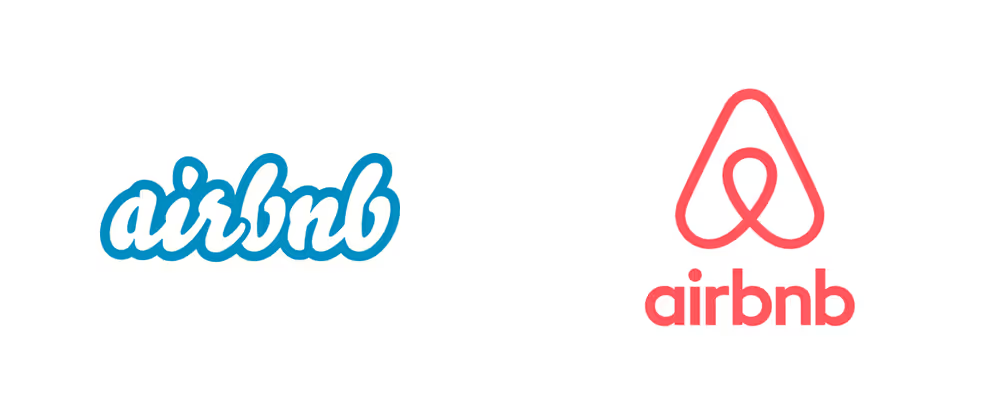
Airbnb Full Rebrand
Full Rebrand
A full rebrand by rebranding agency rethinks everything. Positioning shifts. Personality evolves. Visual identity transforms. Name might change.
Strategic repositioning. The original positioning no longer fits market reality, competitive landscape, or company direction. You need to claim new territory.
Complete visual transformation. New logo, new colors, new typography — a fresh visual system that may or may not reference the previous identity.
Verbal identity overhaul. New messaging framework, potentially new tone of voice, possibly new name.
Characteristics of a full rebrand:
Strategic foundation changes
Recognition assets may be abandoned
Revolution, not evolution
Higher risk, higher cost, slower execution
Appropriate when the brand itself is the problem
The distinction matters because the solutions are different. If your strategy is sound but visuals are dated, you need a refresh, not a rebrand. If your fundamental positioning is wrong, a visual refresh won't fix it.
Misdiagnosis is expensive. A company that needs strategic repositioning but only refreshes visuals wastes money on cosmetics. A company that only needs modernization but does a full rebrand destroys equity unnecessarily.
Signs You Need to Rebrand
How do you know if it's time? These signals suggest the question deserves serious consideration.
Market Signals
You're consistently losing to competitors on perception, not product.
Prospects choose alternatives even when your product is objectively better. In sales conversations, you hear "they just seemed more established" or "their brand felt more trustworthy." The gap isn't features — it's perception.
This is particularly painful because you know your product is better. But perception is reality in buying decisions. If your brand can't communicate your actual quality, you're fighting with one hand tied.
Your category has fundamentally shifted.
What you do hasn't changed, but how the market thinks about the category has. New entrants, new technology, or new customer expectations have redefined what "good" looks like. Your brand was built for a context that no longer exists.
Example: A company positioned as "cloud software" in 2015 might find that positioning meaningless in 2025 — everything is cloud now. The category context that made the positioning distinctive has evaporated.
New competitors have reset expectations.
A disruptor entered with modern brand execution, making everyone else look dated. They didn't just compete on product — they competed on how the category should feel. The bar moved, and you didn't move with it.
Think about how Stripe reset expectations for developer-focused fintech. Or how Notion changed what productivity software could look like. Competitors who didn't respond looked instantly dated.
You can't command fair pricing.
Despite strong product, you're forced to compete on price because the brand doesn't support premium positioning. Customers assume you're the "budget option" based on how you present, even when your product is comparable to premium alternatives.
Millward Brown research shows strong brands command 13% price premiums. If you're leaving that margin on the table because of brand perception, the ROI on rebranding is clear.
Geographic expansion reveals problems.
The brand that worked in your home market doesn't translate. Name, messaging, or visual associations create barriers in new regions. What felt distinctive domestically feels generic or problematic internationally.
Internal Signals
You've outgrown the founder brand.
Many startups launch with whatever the founder threw together — a logo from a $50 contest, colors picked randomly, messaging written at 2am. That worked at five people and zero revenue. It doesn't work at fifty people and $5M ARR.
The brand signals "amateur" when you need to signal "established." Investors notice. Enterprise buyers notice. Candidates notice. The brand that was "good enough to start" is now actively holding you back.
The brand doesn't match what you've become.
Through product evolution, you've become a different company. The startup that was "simple project management for freelancers" is now "enterprise work platform for Fortune 500." The brand was built for the first thing. It can't stretch to fit the second.
This often happens after a successful pivot. The product changed, the customers changed, the value proposition changed — but the brand stayed frozen in the previous era.
Employees are embarrassed.
When your team hesitates to share the website or uses workarounds to avoid branded materials, the brand is actively hurting recruitment and morale. They believe in the product but cringe at the packaging.
This is a leading indicator. If your own team doesn't want to represent the brand, external audiences feel it too.
Every new initiative requires brand gymnastics.
New products, new markets, new partnerships — each requires extensive rationalization because the brand wasn't built to accommodate them. You're constantly explaining why this new thing is "still us" despite looking and feeling different.
M&A integration demands it.
You've acquired companies (or been acquired) and the brand portfolio is incoherent. Multiple identities confuse customers and dilute marketing investment. The post-merger brand needs to be resolved.
Customer Signals
Customers describe you differently than you describe yourself.
When you ask customers what you do, their answer doesn't match your positioning. The brand you think you have isn't the brand customers perceive. That gap, if large enough, indicates strategic misalignment.
Small gaps are normal — customers use their own language. But if the fundamental perception is different from your intent, your brand isn't landing.
You attract the wrong customers.
Your brand appeals to segments you don't want to serve — low-value, high-churn, poor fit. The right customers self-select out because the brand doesn't speak to them. You're spending marketing dollars attracting people who will never succeed with your product.
Awareness without consideration.
People know you exist but don't consider you for purchase. The brand has recognition but not relevance. You're filed in a mental category that doesn't match what you actually offer.
Confusion with competitors.
Customers mix you up with other companies. Your brand lacks distinctive elements that create separation. In a crowded market, you blend into the noise rather than standing out.
Signs You Don't Need a Rebrand
Equally important: recognizing when rebrand urges should be resisted. Many rebrands happen for the wrong reasons.
You're Bored with the Brand
Internal fatigue isn't customer fatigue. You've seen the logo 10,000 times. Customers have seen it 10. What feels stale to you is just becoming familiar to them.
Familiarity is an asset, not a liability. Nielsen research shows 59% of consumers prefer to buy from brands familiar to them. The moment your brand starts feeling "old" internally might be exactly when it's starting to work externally.
Boredom is a terrible reason to rebrand. If the only problem is that leadership is tired of looking at the logo, the solution is not to spend $100K+ on change.
New Leadership Wants to Make a Mark
Incoming executives often push for rebrands to signal change. "New era, new look." It's a visible, tangible way to demonstrate impact.
But rebrands should serve strategy, not egos. The AOL-Time Warner merger rebrand didn't fix the underlying strategic mess. New leadership that prioritizes brand change over business fundamentals is signaling misplaced priorities.
Question the motivation. Is the rebrand driven by market need or political need?
Competitors Rebranded
Someone else's rebrand doesn't obligate your response. If your brand still works, competitor moves might actually strengthen your differentiated position.
When the entire category zigs, you can zag. If every competitor is racing toward minimal, geometric aesthetics, your warmer, more distinctive brand stands out more, not less.
Reactive rebranding is usually bad rebranding.
You Want to Fix Business Problems with Branding
Brand can amplify good strategy. It can't compensate for bad product, weak leadership, broken economics, or poor market fit. Rebranding a failing business produces a failing business with a new logo.
If sales are struggling because of product issues, a rebrand won't help. If churn is high because of service quality, a rebrand won't help. If you're losing because competitors have better solutions, a rebrand won't help.
Be honest about what's actually broken. Brand is rarely the root cause of fundamental business problems.
You Think It'll Be "Easier" to Start Fresh
Accumulated brand equity — even imperfect brand equity — has value. Starting from zero is almost always harder than building from existing recognition.
"Whatever name you choose, be careful. Names stick. You need a way to refer to things, and whatever you call something rapidly becomes its name."— Paul Graham
The same principle applies to brands broadly. Every time someone remembers your name, recognizes your logo, or recalls your positioning — that's equity you've built. Rebranding resets some or all of that to zero.
The grass isn't greener. The new brand will have its own flaws that you'll discover only after committing.
The Rebrand Decision Framework
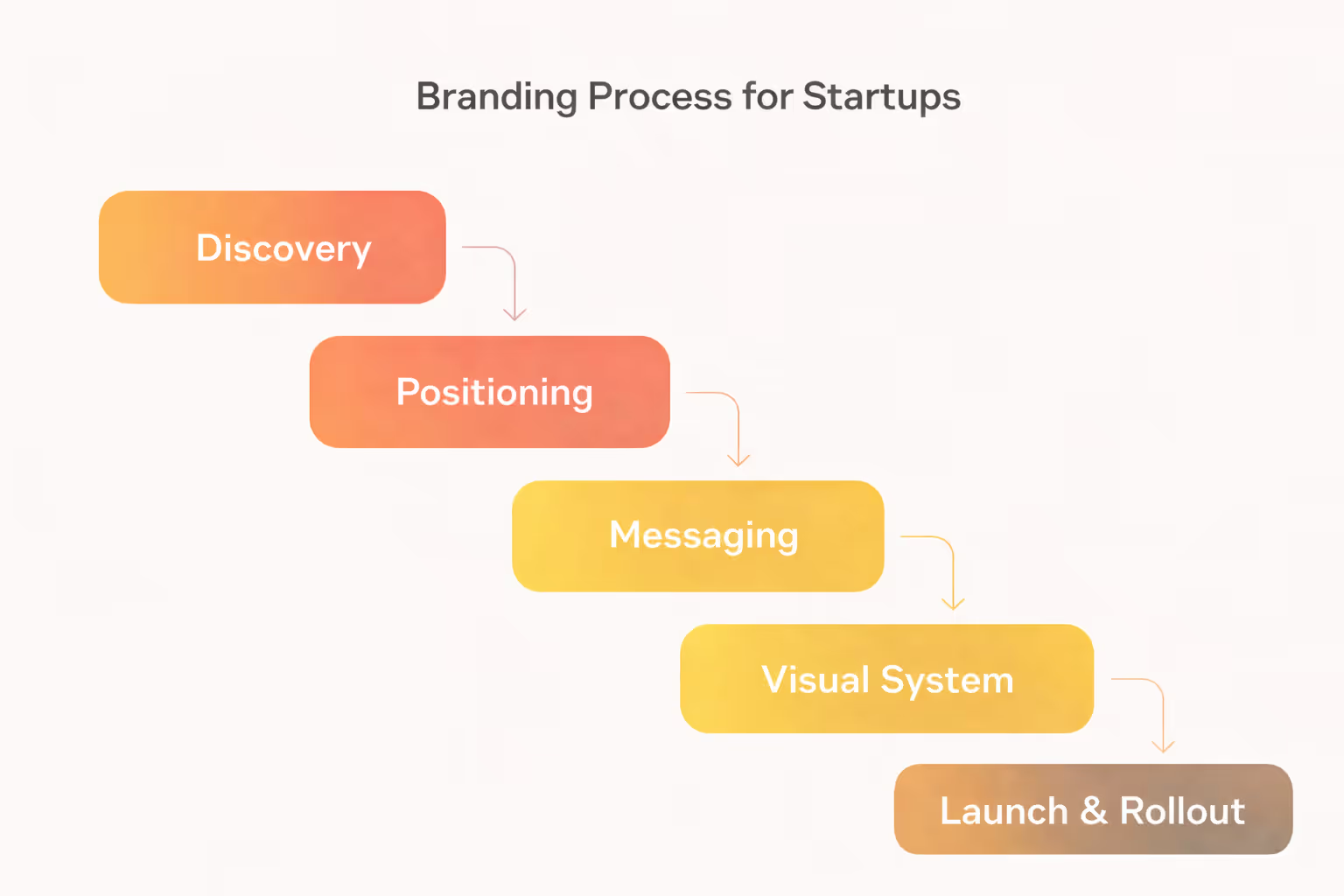
Rebrand Decision and Process Framework by Metabrand
Structured thinking prevents emotional decisions. Work through this framework before committing.
Step 1: Diagnose the Real Problem
What specifically isn't working? Be precise:
Positioning problem: What we stand for is wrong or unclear
Messaging problem: How we communicate doesn't resonate
Visual identity problem: How we look is dated, generic, or inappropriate
Consistency problem: Execution is fragmented across touchpoints
All of the above: The entire brand system needs rethinking
Different problems require different solutions:
Positioning problem → Strategic rebrand
Messaging problem → Messaging refresh (may not need visual change)
Visual problem → Visual refresh (may not need strategic change)
Consistency problem → Guidelines and governance (may not need change at all)
Misdiagnosis leads to wrong treatment. A messaging problem doesn't need a new logo. A consistency problem doesn't need new positioning.
Step 2: Quantify the Cost of Inaction
If you don't rebrand, what happens? Put numbers to it where possible.
Revenue impact:
Lost deals attributable to brand perception?
Price discounts forced by weak brand?
Markets you can't enter effectively?
Efficiency impact:
Higher CAC because brand doesn't support marketing?
Longer sales cycles because of trust gap?
Higher support costs from customer confusion?
Talent impact:
Candidates who declined because of brand perception?
Retention issues from employee embarrassment?
Hiring costs from weak employer brand?
Competitive impact:
Market share loss to better-branded competitors?
Position erosion you can't recover?
Vague dissatisfaction isn't enough. McKinsey research shows that 45% of marketing proposals are rejected because they don't demonstrate clear line to value. Rebrand proposals face the same bar.
Step 3: Quantify the Cost of Action
Rebranding isn't free. Account honestly:
Direct costs:
Agency/consultant fees: $50K-$500K+ depending on scope
Your startup versions are worth less, but they're not worth zero. What do customers recognize? What do they associate with you? List these assets and think carefully before abandoning them.
Emotional associations. What feelings does the current brand evoke? Are they worth preserving?
Even if execution is dated, emotional equity has value. If customers feel trust, warmth, or excitement when they encounter your brand, those feelings took time to build. A rebrand that destroys positive emotions for the sake of "modern" aesthetics is a bad trade.
Functional recognition. How do people find you? What do they type into Google? What do they tell friends?
Search equity, word-of-mouth patterns, directory listings, bookmark folders — all of these are pathways customers use to reach you. Changing them has real cost.
Internal culture. How does the brand shape internal identity?
For early employees especially, the brand is part of their identity. "I work at [brand]" carries meaning for them. Sudden breaks can damage team cohesion and feel like a rejection of shared history.
Document what to protect. Not everything changes.
The Strategic Bridge
Position the rebrand as evolution, not rejection.
Honor the past. Acknowledge what the previous brand accomplished. Teams and customers invested in it. Dismissing that history feels like dismissing them.
Good rebrand narratives: "We started as X, and now we're becoming Y." "The original brand served us well for this phase; now we need to grow into what's next." "We're not leaving behind who we were — we're becoming more fully ourselves."
Bad rebrand narratives: "The old brand was holding us back." "We needed to move past our amateur beginnings." "The previous identity was a mistake."
Explain the why. People accept change they understand. Vague "we wanted something fresh" creates cynicism. Specific "we've expanded from X to Y, and need a brand that reflects both" creates buy-in.
Be honest about the reasons. Employees and customers can smell BS. If you're rebranding because the old brand was hurting sales, say so. If you're rebranding because you've pivoted, explain the pivot.
Connect old to new. Show how the new brand builds on foundations of the old. Even dramatic changes can be framed as fulfillment of original vision rather than abandonment.
Airbnb's 2014 rebrand — controversial at launch — succeeded partly because it connected to the company's core mission of belonging. The new Bélo symbol wasn't random novelty; it was visual expression of existing values: belonging, people, places, and Airbnb itself, all represented in one mark.
Communication Strategy
Rebrand communication has multiple audiences with different concerns.
Internal team (first)
Employees should be first to know and fully briefed. They need to understand and champion the change. Surprise announcements breed resentment.
Internal communication should include:
Why we're rebranding (honest reasons)
What's changing and what's staying
What it means for their work
How to talk about it externally
Timeline and what to expect
How to ask questions and give feedback
Give the team time to process before public announcement. They'll be asked questions — equip them to answer.
Existing customers (second)
Reassure customers that what they value isn't changing. The product still works. The relationship remains. The commitment to them is unchanged. The visual wrapper is what's evolving.
Customer communication should:
Lead with what's not changing (product, service, commitment)
Explain what is changing and why
Address any practical implications (new URLs, new login screens)
Thank them for being part of the journey
Invite feedback
For B2B especially, key accounts may deserve personal outreach from account teams before public announcement.
Prospects and market (third)
Position the rebrand as a positive signal. Rebrands can be positioned as confidence signals — investment in growth, evolution to serve customers better, maturation as a company.
Press and analysts (if newsworthy)
Major rebrands can generate coverage. Have spokespeople prepared. Anticipate skeptical questions. Control the narrative with clear talking points.
Not every rebrand is newsworthy. Seed-stage startup refreshing their logo isn't news. Series C company doing major repositioning might be.
Partners and ecosystem
Companies that co-market with you need notice and assets. Don't surprise them on announcement day. Give advance notice and easy access to updated materials.
Staged communication
The sequence matters: internal → customers → partners → public.
This protects against leaks while building support sequentially. Each group becomes an advocate before the next is informed.
Transition Management
The period between old and new is dangerous. Execute cleanly.
Cutover strategy
Hard cutover (everything changes at once):
Cleaner, no extended inconsistency period
Bigger moment, more impact
Higher risk if anything goes wrong
Requires extensive preparation
Best for: Major rebrands where the break should be visible
Gradual transition (phased updates):
Lower risk, issues can be caught
Less dramatic moment
Extended period of inconsistency
Easier to manage operationally
Best for: Refreshes where continuity matters
Hybrid approach:
Quiet update of digital properties first
Verify everything works
Public announcement once implementation is complete
Create exhaustive inventory. Prioritize updates. Accept that you won't catch everything immediately.
Redirect strategy
Old URLs, old social handles, old email addresses — all need redirect plans. Don't break paths that customers rely on.
301 redirects for URL changes
Email forwarding for address changes
Social handle preservation or clear pointer to new handles
Sunset timeline
When does old brand become unacceptable? Define clear cutoff and enforce it. Extended overlap dilutes both brands.
Set a date after which old brand materials cannot be used. Communicate it clearly. Hold people to it.
Rebrand Case Studies
Success: Slack's 2019 Logo Evolution
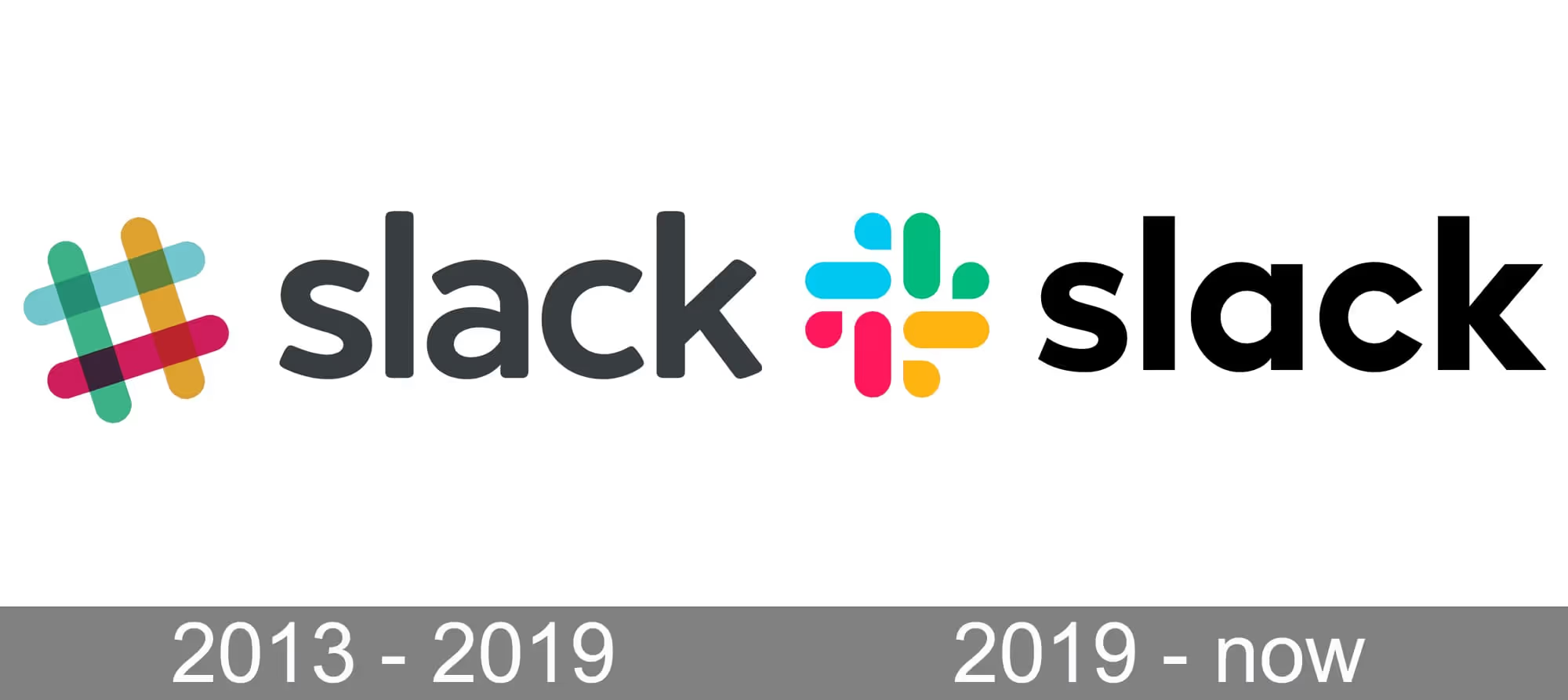
Slack's 2019 Logo Evolution
Slack's rebrand faced initial backlash — as every rebrand does — but ultimately succeeded.
The problem: The original logo (a hashtag made of 11 colors) was difficult to use consistently. It looked different on every background. The colors were unmatchable in print. The plaid pattern was hard to reproduce accurately. Operationally, it was a nightmare.
What they did:
Simplified to four colors while retaining the essential shape
Preserved the hashtag/octothorpe concept (recognition asset)
Made colors reproducible and consistent
Created flexible system that works across contexts
Why it worked:
Clear rationale: The change had functional justification beyond aesthetics
Recognition preservation: The core shape (rotated speech bubbles) was maintained
Comprehensive execution:Pentagram delivered complete system, not just a mark
Confident rollout: They didn't apologize or over-explain
The internet complained for approximately 48 hours. Then everyone moved on. The new logo works better in practice, and no one thinks about the old one anymore.
Success: Stripe's Continuous Evolution
Stripe represents a different approach: they've never done a dramatic rebrand, but they've continuously evolved with sophistication.
The approach:
Core positioning ("financial infrastructure for the internet") has remained stable even as products expanded
Visual design language has evolved progressively — each change feels like natural maturation
Typography, color usage, illustration style have refined over time
No single moment of "rebrand" — just consistent evolution
Why it works:
Never accumulates enough brand debt to require revolutionary change
Each evolution builds on previous equity rather than resetting
Customers experience continuity even as the brand matures
Internal teams can evolve without dramatic change management
Stripe demonstrates that the best rebrand is often no rebrand — continuous evolution that keeps the brand fresh without destroying equity.
Failure: Gap's 2010 Logo Disaster
Gap's infamous logo change lasted exactly six days.
What happened:
New logo replaced the iconic blue box with a small gradient square behind generic Helvetica text
No strategic rationale communicated — appeared arbitrary
Announced via social media with no preparation
Customer backlash was immediate and intense
Company reversed within a week
Why it failed:
No strategic foundation. The change wasn't connected to any business transformation. It appeared random.
Abandoned recognition. The blue box — decades of accumulated equity — was minimized to irrelevance.
Ignored customer attachment. Gap customers had emotional connection to the old logo. The company underestimated what they were abandoning.
Crowd-sourced reversal. The retreat to old logo after outcry made the company look directionless. The damage was worse than never changing.
The lesson: Rebranding without clear strategic reason, while abandoning recognition assets, invites disaster.
Failure: Tropicana's 2009 Packaging Rebrand
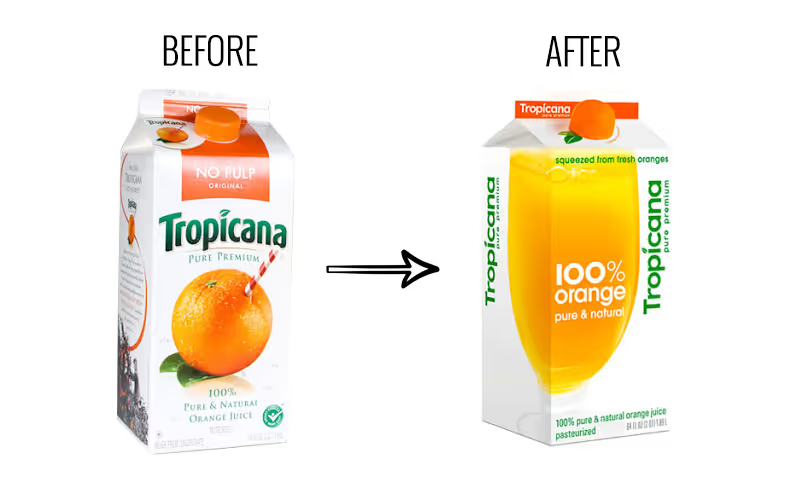
Tropicana's 2009 Packaging Rebrand
Tropicana's packaging redesign is a textbook case of destroying brand equity.
What happened:
Removed the iconic orange-with-straw image
Changed the distinctive cap (shaped like an orange half)
New design was "cleaner" and "more contemporary"
Everything recognizable was eliminated
The result:
Sales dropped 20% in one month
Customers literally couldn't find the product on shelves
$30M in lost sales during the brief change
Company reverted to old packaging, eating entire rebrand investment
Why it failed:
Over-indexed on "modern" at the expense of recognition
The iconic elements were functional — they helped customers find the product
"Cleaner" design was also more generic — indistinguishable from store brands
No testing revealed what would happen at shelf
The lesson: Recognition in crowded environments is worth protecting. "Modern" isn't a strategy. Test before committing.
RadioShack tried multiple rebrands in its dying years, including the widely mocked "The Shack" campaign.
What happened:
Core business was failing (electronics retail disrupted by online)
Leadership hoped rebrand would signal relevance
New names, new campaigns, new store designs — multiple attempts
Each rebrand consumed resources without addressing real problems
Company eventually went bankrupt
Why it failed:
Brand wasn't the problem — business model was
Rebrand was a distraction from necessary transformation
Resources spent on cosmetic changes instead of fundamental innovation
The lesson: You can't rebrand your way out of a broken business. Brand amplifies strategy; it can't substitute for it.
Post-Rebrand: Measuring Success
How do you know if the rebrand worked? Establish metrics before launching.
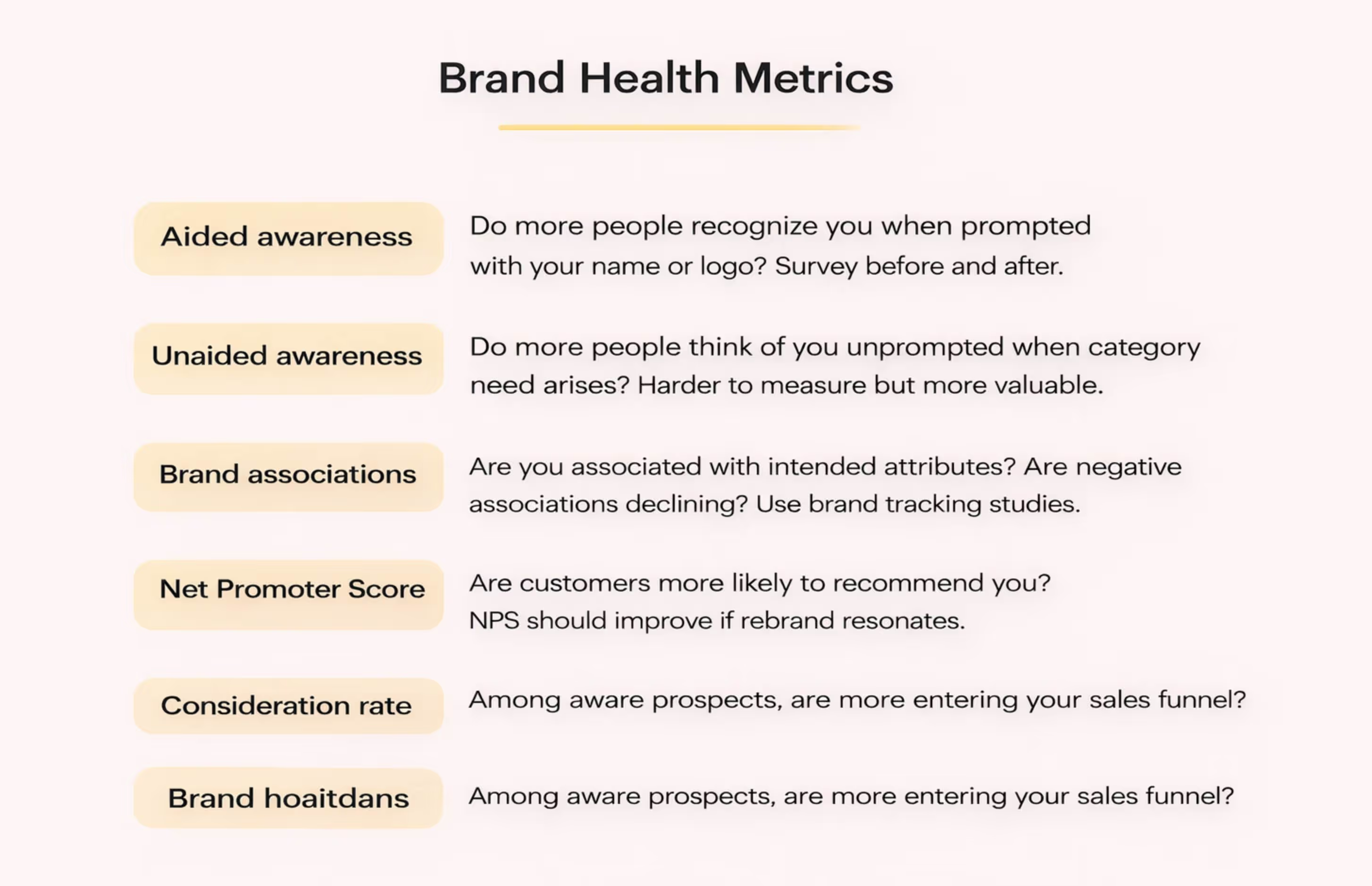
Brand Health Metrics by Metabrand
Brand Health Metrics
Aided awareness: Do more people recognize you when prompted with your name or logo? Survey before and after.
Unaided awareness: Do more people think of you unprompted when category need arises? Harder to measure but more valuable.
Brand associations: Are you associated with intended attributes? Are negative associations declining? Use brand tracking studies.
Net Promoter Score: Are customers more likely to recommend you? NPS should improve if rebrand resonates.
Consideration rate: Among aware prospects, are more entering your sales funnel?
Survey-based measurement at regular intervals (quarterly or annually) tracks these over time.
Business Metrics
Customer acquisition cost: Strong brands reduce CAC. Track trend before and after rebrand.
Conversion rates: Are prospects converting at higher rates? Website conversion, demo requests, trial sign-ups.
Pricing power: Can you raise prices without losing customers? Can you reduce discounting?
Talent acquisition: Are you receiving more qualified applications? Improving offer acceptance rates?
Sales velocity: Are deals closing faster?
Connect brand investment to business outcomes. The ROI case made before rebranding should be validated after.
Implementation Metrics
Brand compliance audit: Across touchpoints, how consistently is the new brand applied? Conduct periodic audits.
Time to consistency: How long until all touchpoints reflect the new brand?
Guideline adoption: Are teams using brand assets and templates? What barriers exist?
Sentiment monitoring: What are customers saying about the change? Social listening, support tickets, direct feedback.
The best rebrand strategy, poorly executed, fails. Measurement should track implementation quality, not just strategic intent.
Timeline for Results
Immediate (0-3 months):
Internal alignment and adoption
Implementation completeness
Initial sentiment feedback
Short-term (3-6 months):
Conversion rate trends
Sales feedback on brand reception
Customer sentiment patterns
Medium-term (6-12 months):
CAC trends
Awareness metrics
Pricing power evidence
Long-term (1-3 years):
Market position change
Competitive differentiation
Talent acquisition metrics
Valuation impact (if measurable)
Brand is a compounding asset. Don't expect immediate ROI, but do establish metrics that will reveal impact over time.
The Rebrand Decision Checklist
Rebrand When:
☐ Strategic foundation is broken — positioning no longer fits market reality
☐ Brand actively hurts business outcomes — losing deals on perception, not product
☐ Company has fundamentally transformed — pivot, M&A, or evolution makes current brand obsolete
☐ Target market has shifted — the customers you now serve weren't who the brand was built for
☐ Competitive landscape has reset — new entrants have changed what "good" looks like
☐ Legal issues force it — trademark conflicts, acquisition requirements
Don't Rebrand When:
☐ Leadership is bored with current brand — internal fatigue isn't customer fatigue
☐ New executives want to make their mark — rebrand should serve strategy, not egos
☐ Competitors rebranded — their move doesn't obligate yours
☐ Business is struggling — brand can't fix product, market fit, or business model problems
☐ You think starting fresh is easier — existing equity has value, even imperfect equity
☐ The problem is execution, not strategy — better guidelines may solve consistency issues
If You Rebrand:
☐ Diagnose the actual problem — strategic, messaging, visual, or consistency
☐ Quantify cost of inaction — make the business case specific
☐ Quantify true cost of action — including implementation, transition, and risk
☐ Consider intermediate options — maybe a refresh solves 80% of the problem
☐ Preserve recognition assets where possible — don't destroy equity unnecessarily
☐ Connect old to new — evolution narrative, not rejection
☐ Communicate staged — internal first, customers second, public third
☐ Execute with confidence — hesitant rebrands fail more than bold ones
☐ Measure before, during, and after — validate the business case
Summary: Rebrand Deliberately
Rebranding is a powerful tool. Like any powerful tool, it causes damage when misused.
The best rebrands are deliberate:
Clear diagnosis of the actual problem
Honest assessment of costs and benefits
Preservation of equity where possible
Confident execution with clear communication
Measurement to validate impact
The worst rebrands are reactive:
Driven by boredom, ego, or competitive anxiety
Solving the wrong problem
Destroying equity unnecessarily
Executed tentatively with hedging
Never measured for actual impact
If you find yourself genuinely needing a rebrand — because strategy has shifted, because the brand is actively hurting you, because the company has fundamentally changed — then do it with full commitment. Half-measures fail.
If you're not sure, you probably shouldn't. The bar for rebrand should be high. Accumulated brand equity is valuable. The pain of change is real. The grass isn't greener.
But when the time is right, a well-executed rebrand accelerates everything. It signals transformation, attracts the right customers, excites the team, and positions you for the next phase of growth.
Make the decision deliberately. Then execute with confidence.
Frequently Asked Questions
How do I know if my startup needs a rebrand or just a refresh?
A refresh updates execution while maintaining strategic foundation — new logo, modernized colors, tightened messaging, but same core positioning and brand meaning. A rebrand transforms strategy — new positioning, potentially new name, completely new identity. You need a refresh when your brand looks dated but your strategy is sound. You need a rebrand when your strategy has fundamentally changed, your positioning no longer fits your market, or your brand actively hurts your business. Rebrands are 5-10x more expensive and risky than refreshes.
What are the biggest risks of rebranding a startup?
The biggest risks: losing recognition equity you've built (especially dangerous if you change names), confusing existing customers who no longer recognize you, internal resistance that undermines execution, underestimating implementation costs and scope, and launching before you're ready — leaving the market confused by half-implemented change. Mitigate by preserving recognition assets where possible, communicating changes clearly to existing customers, ensuring internal buy-in before external launch, budgeting 2-3x the agency fee for full implementation, and planning comprehensive rollout before announcement.
How long does a startup rebrand take?
A comprehensive rebrand typically takes 4-8 months from kickoff to full implementation. The breakdown: discovery and strategy (4-8 weeks), identity development (6-12 weeks), guidelines and asset creation (4-6 weeks), implementation across touchpoints (8-16 weeks depending on scope). Many phases overlap. A lighter refresh can happen in 2-3 months. Timelines extend with complexity — more stakeholders, more touchpoints, more markets. Rush timelines increase risk of poor outcomes or incomplete implementation.
Ready to scope your rebrand?
If the signals above apply to your situation, rebranding agency services typically start with a positioning audit before any creative work begins.