By clicking "Accept all cookies", you agree to storing cookies on your device to enhance site navigation, analyze site usage and assist in our marketing efforts as outlined in our privacy policy.
By clicking 'Accept all cookies', you agree to storing cookies on your device to enhance site navigation, analyze site usage and assist in our marketing efforts as outlined in our privacy policy.
Branding isn't magic. It's not a creative lightning bolt that strikes talented designers. It's not subjective opinion dressed up as strategy.
Branding is a process. A rigorous, repeatable methodology that transforms business inputs into brand outputs.
Companies that approach branding without process get predictable results: endless debates about logo colors, messaging that changes with every meeting, visual identity disconnected from strategy, and teams that can't explain what the brand stands for.
Companies that follow proven process get different results: clear positioning that guides decisions, visual identity grounded in strategy, messaging that resonates because it's based on research, and teams aligned around a shared understanding.
The methodology in this guide is used by top agencies like Pentagram, Landor, and Wolff Olins, adapted for startup timelines and budgets. It's the same process that startup branding agency Metabrand uses with clients from seed stage through Series C.
This guide covers:
The five phases of brand development
What happens in each phase
Key activities and deliverables
Timeline and resource expectations
How to run the process yourself
Common process mistakes and how to avoid them
Let's build your brand systematically.
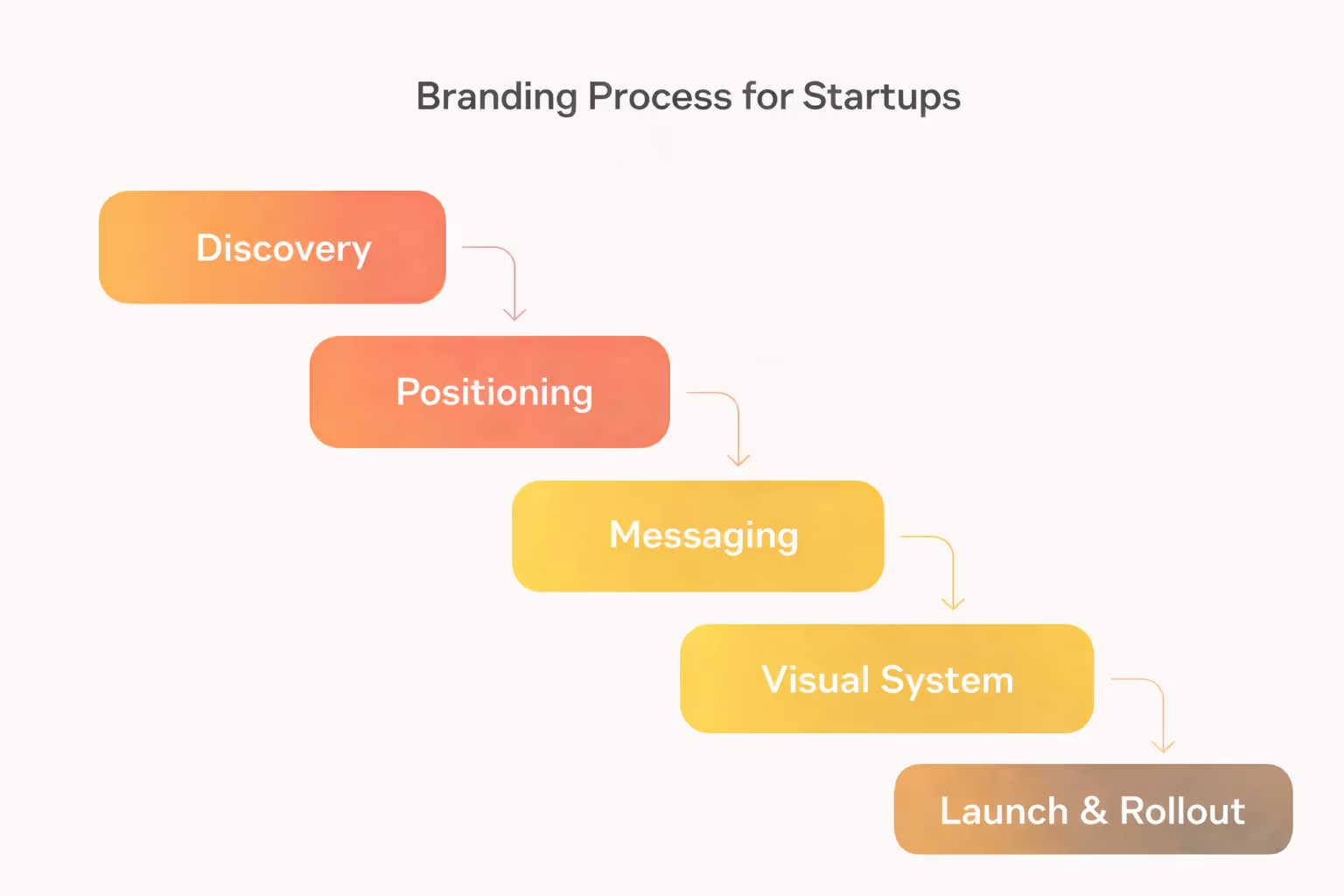
The Five Phases of Brand Development
Brand development process by Metabrand
Every comprehensive brand development process follows five phases:
Phase 1: Discovery — Understanding before creating Phase 2: Strategy — Making the hard choices Phase 3: Verbal Identity — Finding your voice Phase 4: Visual Identity — Making strategy visible Phase 5: Activation — Bringing brand to life
Each phase builds on the previous. Skip any phase and the foundation cracks. Rush through and you'll rebuild later at 10x the cost.
Phase 1: Discovery
Duration: 2-4 weeksPurpose: Gather the inputs that inform every downstream decision
Discovery is research. You're collecting information about your company, customers, competitors, and market that will shape positioning and identity.
Most branding failures trace back to skipped discovery. Teams jump straight to logos, build on assumptions, and create brands that don't resonate because they weren't grounded in understanding.
Stakeholder Interviews
Start inside. Interview founders, executives, and key team members.
What you're looking for:
Vision alignment (or misalignment). Do the founders agree on where the company is going? Disagreements that surface now can be resolved. Disagreements that surface during logo review derail projects.
Origin story. Why does this company exist? What problem made the founders angry enough to quit their jobs and start something? The emotional core of the brand often lives here.
Competitive perception. How do insiders see the competitive landscape? Who do they respect? Fear? Dismiss? Their mental map reveals positioning opportunities.
Culture and values. What behaviors get rewarded? What would get someone fired? Culture shapes brand from the inside out.
Sample questions:
Why did you start this company?
What would success look like in 5 years?
Who are our best customers and why?
What do we do better than anyone else?
What do competitors do that frustrates you?
If our company were a person, how would you describe them?
Conduct: 30-60 minute interviews with 3-8 key stakeholders depending on company size.
Customer Research
Internal perspectives matter, but customers have the final vote.
Current customers:
Why did they choose you?
What alternatives did they consider?
What almost stopped them from buying?
How would they describe you to a colleague?
What would they miss if you disappeared?
Churned customers:
Why did they leave?
What was missing?
Where did you fail to deliver on promises?
Prospects who didn't convert:
What did they choose instead?
How did they perceive you vs. the alternative?
What would have changed their mind?
Methods:
Live interviews (most valuable — you can follow threads)
Surveys (useful for scale, less depth)
Review mining (G2, Capterra, app stores, social mentions)
Support ticket analysis (how customers describe problems)
Conduct: 8-15 customer interviews for meaningful patterns. Supplement with survey for quantitative validation if needed.
Competitive Analysis
Map your competitive landscape systematically.
Direct competitors: Companies selling similar products to similar customers.
How do they position themselves?
What visual and verbal patterns define the category?
What claims do they make?
Where are they strong? Weak?
Indirect competitors: Alternative solutions to the same problem.
A project management startup competes with other PM tools, but also with spreadsheets, email, and "we'll just figure it out"
What are customers doing instead of buying your category?
Aspirational references: Brands outside your category that you admire.
Strategic implications (what this means for brand direction)
Share and align: Present discovery findings to stakeholders before moving to strategy. Ensure everyone agrees on the inputs before making strategic choices.
Phase 2: Strategy
Duration: 2-3 weeks Purpose: Make the defining decisions about who you are and how you'll compete
Strategy is where you make choices. What to be. What not to be. Who you're for. Who you're not for.
These choices are hard because they require saying no. Positioning for "engineering teams" means not positioning for "all teams." Claiming "simplicity" means not claiming "comprehensive." Strategy requires courage to exclude.
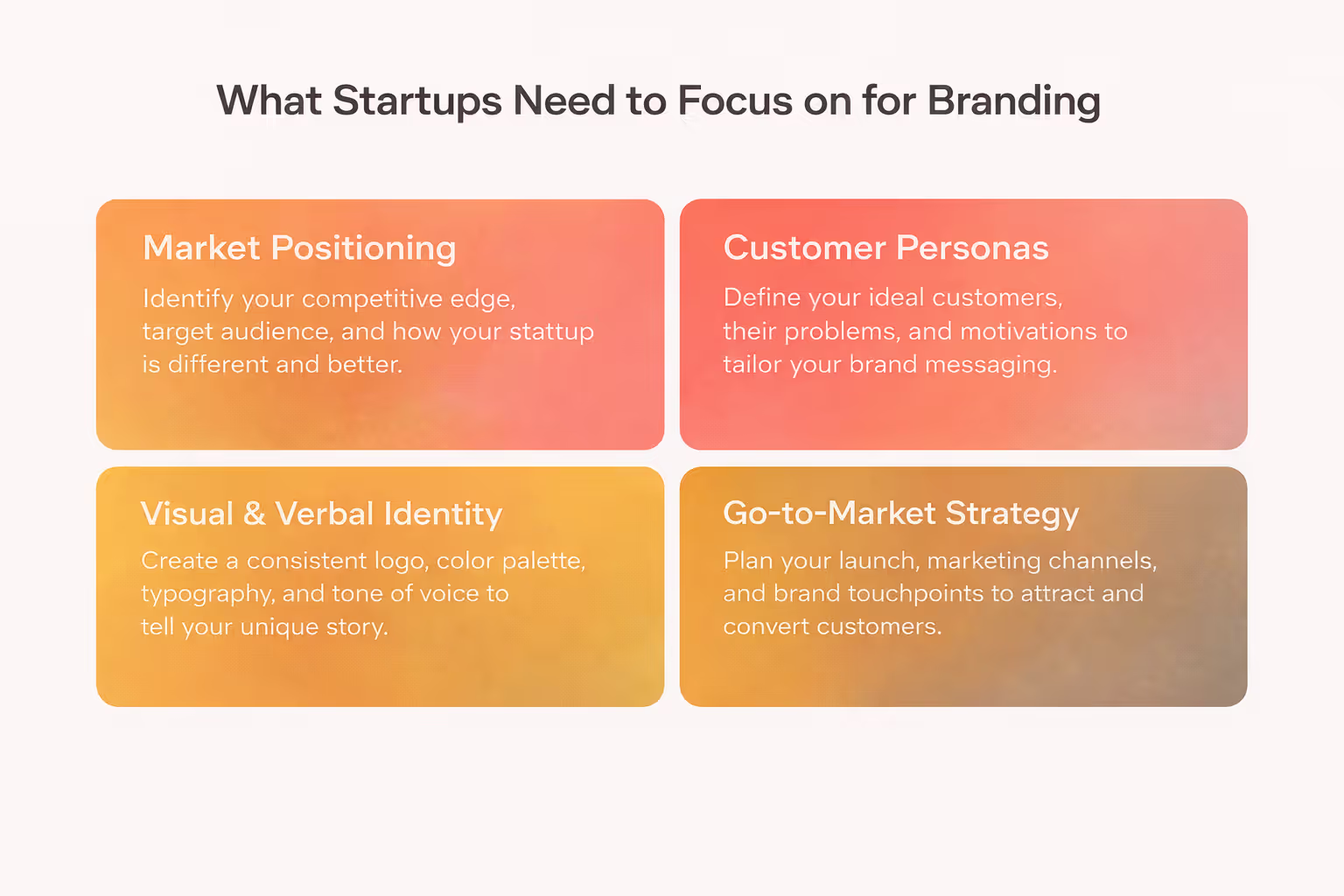
Startup needs to focus on Branding by Metabrand
Positioning Development
Positioning is the most important strategic decision.
"It all starts with nailing down your positioning. Everything stems from that."
The positioning framework:
For (target customer) Who (statement of need or opportunity),(Product name) is a (product category)That (statement of key benefit).Unlike (competing alternative),(Product name) (statement of primary differentiation).
Working through each element:
Target customer: Not "everyone who might buy." The specific segment you're optimizing for. Who are your best customers? What do they have in common?
Need or opportunity: What problem are they trying to solve? What job are they hiring you to do?
Category: What mental bucket do you occupy? Existing category, subcategory, or new category?
Key benefit: The primary value you deliver. Not a feature — the outcome customers care about.
Competing alternative: What would customers do if you didn't exist? Direct competitors, indirect alternatives, or status quo.
Primary differentiation: What makes you unlike alternatives? Must be true, relevant, and defensible.
Process:
Draft multiple positioning options based on discovery insights
Evaluate each against criteria (true, differentiated, relevant, ownable)
Pressure test with stakeholders
Select and refine winning positioning
Brand Platform Development
The brand platform synthesizes strategy into a usable framework.
Components:
Purpose: Why the company exists beyond making money. The foundational reason that wouldn't change even if product pivoted.
Vision: The future state you're working toward. What the world looks like if you succeed.
Mission: How you pursue the vision. What you do daily.
Values: The principles that guide behavior. Not aspirational posters — actual decision-making criteria. What behaviors get rewarded? What's non-negotiable?
Personality: Human characteristics that define how the brand shows up. If the brand were a person, how would you describe them? (3-5 attributes)
Brand essence: The single idea at the heart of everything. The one thing the brand would be known for.
Process:
Workshop with leadership to develop each element
Draft platform document
Review and refine with stakeholders
Finalize as strategic foundation
Brand Architecture (If Needed)
For companies with multiple products, services, or sub-brands:
Monolithic (branded house): Everything under one brand.
Google products are all Google
Simpler, but constrains how different products can feel
Endorsed: Sub-brands with parent connection.
Courtyard by Marriott
Flexibility with credibility transfer
Pluralistic (house of brands): Independent brands.
P&G owns Tide, Pampers, Gillette
Maximum flexibility, maximum complexity
For most startups: Default to monolithic. You don't have brand equity to transfer, and managing multiple brands dilutes focus.
Strategy Deliverables
Phase 2 produces:
Positioning statement (using First Round or similar framework)
Alignment checkpoint: Before moving to Phase 3, ensure all stakeholders approve strategy. Changes after this point are expensive.
Phase 3: Verbal Identity
Duration: 2-4 weeksPurpose: Translate strategy into language
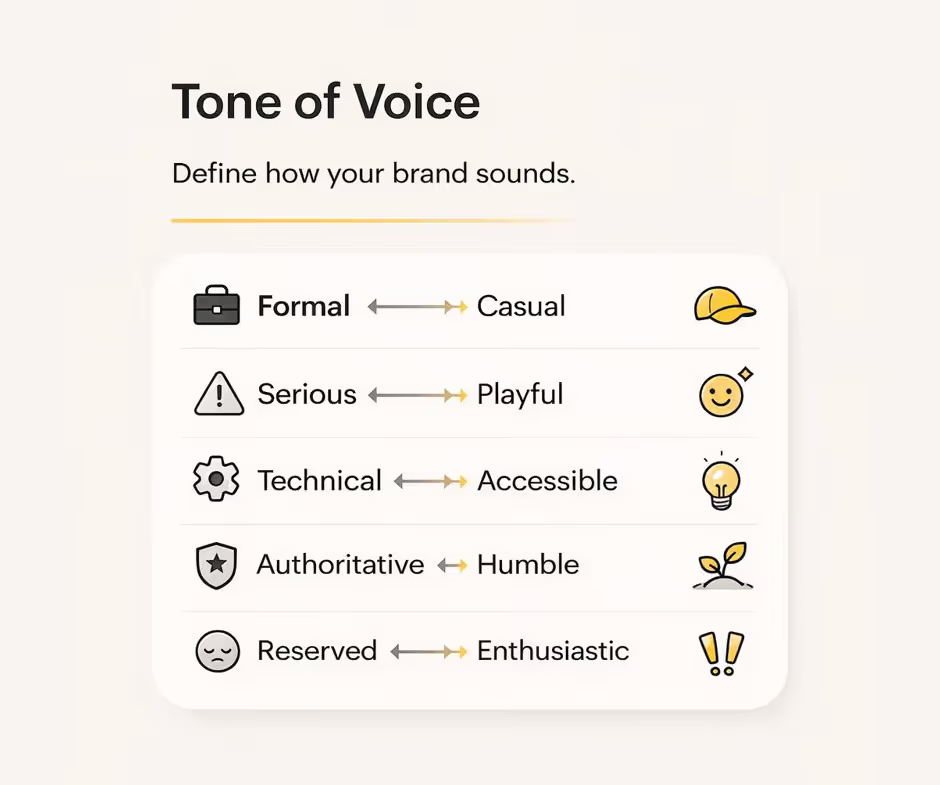
Verbal identity is how your brand sounds — the words, phrases, and communication style that express your positioning.
Naming (If Needed)
If you're naming a new company, product, or doing a rebrand with name change:
Naming process:
Generate candidates: Cast wide net. 200-500 options before filtering. Use brainstorming, thesaurus exploration, etymology research, compound creation, foreign language mining, and name generators.
If you're running brand development internally (with or without external help):
Establish Clear Governance
Decision-maker: Who has final authority? One person should be able to make calls when opinions differ.
Input vs. approval: Who provides input? Who must approve? These are different roles. Gather input broadly, decide narrowly.
Timeline authority: Who can extend timelines? Who can cut scope to meet deadlines?
Create Feedback Structure
Structured reviews: Schedule feedback sessions rather than ad-hoc comments. Consolidated feedback is easier to act on.
Feedback format: Require structured feedback. "I don't like it" isn't actionable. "This feels too playful for our enterprise audience because..." is actionable.
Revision limits: Define how many rounds of revision at each stage. Unlimited revision creates endless projects.
Maintain Momentum
Regular check-ins: Weekly at minimum during active development.
Decision deadlines: Set specific deadlines for decisions. "We'll decide on direction by Friday."
Decision log: Track what was decided, when, and why. When someone asks "why did we choose blue?" you'll have the answer.
Version control: Keep versions of all deliverables. You may need to reference or revert.
Rationale documentation: Capture the thinking behind choices. Future team members will want to understand.
Common Process Mistakes
Mistake 1: Skipping Discovery
What happens: Team jumps straight to design based on assumptions. Brand doesn't resonate because it wasn't grounded in understanding.
Fix: Always do discovery. Even lightweight discovery (10 customer interviews, competitive audit, stakeholder alignment) dramatically improves outcomes.
Mistake 2: Strategy by Committee
What happens: Everyone has input on positioning. Compromise produces vague, undifferentiated positioning that satisfies no one and excites no one.
Fix: Small team makes strategic decisions. Gather input broadly, then 2-3 people make the call. Stakeholder veto power kills good strategy.
Mistake 3: Designing Before Strategy
What happens: Visual identity is developed without strategic foundation. Pretty designs don't express positioning because positioning wasn't defined.
Fix: Complete strategy before any design work. Designers need strategic brief to do good work.
Mistake 4: Premature Convergence
What happens: Team falls in love with first concept. Doesn't explore alternatives. Misses better options.
Fix: Force exploration. Require multiple directions before selecting. Live with options before committing.
Mistake 5: Endless Refinement
What happens: Pursuit of perfection prevents completion. Small changes lead to more small changes. Project never finishes.
Fix: Set revision limits. Define "good enough." Remember that brand improves through use, not endless refinement.
Mistake 6: Implementation Abandonment
What happens: Strategy and identity are developed, but implementation doesn't happen. Team is exhausted, budget is spent. Brand exists in documents but not in reality.
Fix: Reserve budget and energy for activation. Implementation is where brand actually happens.
Mistake 7: No Ongoing Stewardship
What happens: Brand launches, then drifts. No one owns ongoing consistency. Guidelines are ignored. Brand fragments.
Brand development is a project. Brand management is ongoing.
Governance Structure
Brand owner: Someone responsible for brand consistency and evolution. Could be marketing lead, brand manager, or founder.
Approval process: How are brand decisions made? Who can approve what?
Exception handling: What happens when someone needs to break guidelines? Process for requesting and granting exceptions.
Regular Review
Quarterly: Review consistency across touchpoints. Address drift.
Semi-annually: Assess brand health metrics. Identify improvement opportunities.
Annually: Strategic brand review. Is positioning still relevant? Does identity still work?
Evolution vs. Revolution
Brands should evolve:
Continuous small improvements: Refine details, expand system, add applications.
Periodic refreshes: Modernize execution while maintaining strategic foundation.
Occasional transformation: When strategy changes, brand may need to change with it.
See When to Rebrand for guidance on refresh vs. rebrand decisions.
Process Checklist
Phase 1: Discovery
☐ Stakeholder interviews conducted ☐ Customer research completed ☐ Competitive analysis documented ☐ Market context understood ☐ Discovery synthesis created and shared
Phase 2: Strategy
☐ Positioning statement developed ☐ Brand platform defined (purpose, vision, mission, values, personality) ☐ Brand architecture determined (if applicable) ☐ Strategic brief created ☐ Stakeholder alignment confirmed
Phase 3: Verbal Identity
☐ Name developed (if applicable) ☐ Messaging framework created ☐ Tone of voice defined ☐ Stakeholder approval received
Phase 4: Visual Identity
☐ Logo developed with all variations ☐ Color system defined ☐ Typography system established ☐ Supporting elements created ☐ All assets finalized
Phase 5: Activation
☐ Brand guidelines documented ☐ Priority touchpoints designed ☐ Internal launch completed ☐ External launch executed ☐ Governance structure established
Summary: Process Creates Quality
Branding isn't magic. It's methodology.
Follow the process:
Discovery grounds your brand in reality — what customers need, what competitors do, where opportunity exists.
Strategy forces the hard choices — who you're for, what you stand for, how you're different.
Verbal identity translates strategy into language — words that communicate clearly and consistently.
Visual identity makes strategy visible — design that expresses positioning and creates recognition.
Activation brings brand to life — deployment across touchpoints where brand meets audience.
Skip steps and you build on sand. Follow the process and you build something that lasts.
Frequently Asked Questions
What are the main phases of the branding process?
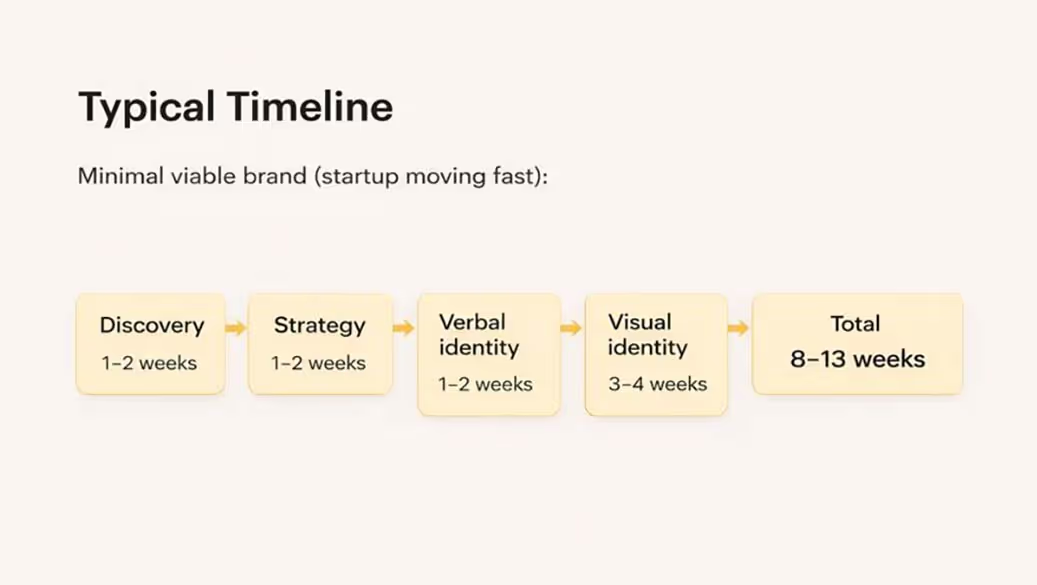
A comprehensive brand development process has five phases: Discovery (2-4 weeks) — research on customers, competitors, and internal stakeholders to ground decisions in understanding. Strategy (2-3 weeks) — defining positioning, brand platform, and strategic choices. Verbal identity (2-4 weeks) — naming if needed, messaging framework, tone of voice. Visual identity (4-8 weeks) — logo, colors, typography, supporting elements. Activation (4-8 weeks) — guidelines, priority touchpoints, launch, and governance. Total timeline: 8-27 weeks depending on scope and complexity. Phases can overlap.
What's the biggest mistake companies make in the branding process?
Skipping discovery. Teams eager to see logos jump straight to design, building on assumptions about customers and market. The result: beautiful work that doesn't resonate because it wasn't grounded in reality. Discovery — customer research, competitive analysis, stakeholder alignment — takes 2-4 weeks and feels slow. But it prevents expensive mistakes downstream. Other common mistakes: strategy by committee (produces vague positioning), designing before strategy is set, premature attachment to first concepts, and abandoning implementation after identity is developed.
Can I run a branding process without an agency?
Yes, with caveats. You can run discovery (interviews, competitive research, synthesis). You can facilitate strategy workshops using frameworks like First Round's positioning template. For visual identity, you'll likely need design expertise — either a freelance designer or small boutique. What you lose without an agency: external perspective (they see patterns you can't), process rigor (they've done this many times), and specialized skills across strategy, design, and copywriting. If running internally, assign a clear project owner, establish governance, document decisions, and consider hiring an experienced freelancer for phases where you lack expertise.
Ready to Start?
If you're ready to build your brand — and want a partner to guide the process — we can help.
Metabrand runs this process with tech startups from seed through Series C. We bring methodology, expertise, and efficiency to brand development.